Protein Stabilization Introduction in UHT Processing
In modern liquid food processing, achieving commercial sterility is not the only challenge. Maintaining product stability, preventing protein aggregation, and ensuring consistent quality throughout the shelf life are equally important.
For UHT (Ultra High Temperature) processed products, especially dairy and high-protein beverages, protein stabilization is a critical process step that directly affects product appearance, texture, viscosity, and storage stability.
During UHT treatment, products are exposed to extremely high temperatures for a short period of time. Without proper protein stabilization, heat-sensitive proteins may undergo uncontrolled denaturation and aggregation, resulting in:
- Protein sedimentation
- Phase separation
- Increased viscosity
- Gel formation during storage
- Reduced product quality
A properly designed protein stabilization system helps manufacturers produce stable, high-quality products with extended shelf life.
What Is Protein Stabilization in UHT Processing?
Protein stabilization is a controlled heating and holding process before UHT sterilization, designed to improve the thermal stability of proteins.
- Protein stabilization in milk and dairy products
In milk and dairy products, milk proteins mainly consist of:
- Casein (approximately 80%)
- Whey proteins (approximately 20%)
Among whey proteins, β-lactoglobulin is particularly sensitive to heat.
During heating, β-lactoglobulin unfolds and interacts with κ-casein on the surface of casein micelles. If this reaction is not properly controlled, protein aggregation may occur during UHT processing or during long-term storage.
The protein stabilization section allows these protein changes to occur in a controlled manner, improving the stability of the final product.
2. Protein stabilization in plant-based milk products
Plant-based protein beverages, including soy milk, oat milk, pea protein drinks, and almond milk, have become increasingly popular due to growing demand for dairy alternatives.
However, compared with dairy milk, plant-based beverages have more complex stability challenges. Plant proteins naturally exist as irregular protein particles rather than stable casein micelles, making them more sensitive to heat treatment, pH changes, and ionic conditions.
During UHT processing and long-term storage, unstable plant proteins may cause:
- Protein sedimentation
- Phase separation
- Flocculation
- Increased viscosity
- Grainy mouthfeel
- Reduced shelf-life stability
Therefore, a properly designed protein stabilization process is essential for producing high-quality plant-based beverages.
Why Is Protein Stabilization Important?
- Control Protein Denaturation and Aggregation
During UHT sterilization, temperatures can reach:
- 138–140°C for indirect UHT systems
- 140–150°C for direct steam injection (DSI) UHT systems
The rapid temperature increase can create thermal stress on proteins.
A protein stabilization stage helps:
- Control whey protein denaturation
- Improve protein-protein interactions
- Reduce uncontrolled aggregation
- Maintain product uniformity
- Improve Shelf-Life Stability
Many UHT products require storage at room temperature for 6–12 months.
During storage, unstable proteins may continue to interact and form a protein network, causing:
- Sedimentation
- Increased viscosity
- Age gelation
- Texture changes
Proper protein stabilization improves the physical stability of products throughout their shelf life.
- Reduce Heat Shock During UHT Sterilization
The temperature difference between raw milk and UHT sterilization is significant.
For example:
- Raw milk temperature: 4–10°C
- UHT sterilization temperature: around 140°C
Protein stabilization provides a gradual heat adaptation stage before the final ultra-high-temperature treatment, reducing heat-induced instability.
What Products Require Protein Stabilization During UHT Processing?
Protein stabilization is mainly used for liquid food products containing milk proteins or plant proteins that are sensitive to heat treatment.
- UHT Milk
UHT milk is the most common application of protein stabilization technology.
During UHT processing, milk proteins can be affected by high temperatures, resulting in sediment formation or gelation during storage.
Protein stabilization helps:
- Improve long-term shelf stability
- Reduce protein sedimentation
- Maintain smooth mouthfeel
- Improve consumer acceptance
Typical products include:
- Full-fat UHT milk
- Low-fat milk
- Skimmed milk
- Lactose-free milk
- Flavored Milk and Dairy Beverages
Flavored milk contains additional ingredients such as:
- Sugar
- Cocoa
- Fruit ingredients
- Vitamins and minerals
These components may influence protein stability during heat treatment.
Protein stabilization helps prevent:
- Protein precipitation
- Phase separation
- Texture changes
Applications include:
- Chocolate milk
- Strawberry milk
- Coffee milk beverages
- Nutritional dairy drinks
- High-Protein Dairy Beverages
High-protein beverages contain higher protein levels compared with standard milk.
Examples include:
- Sports nutrition drinks
- Protein milk shakes
- Medical nutrition beverages
- Functional dairy drinks
Because of the increased protein concentration, these products have higher risks of:
- Protein aggregation
- Excessive viscosity increase
- Storage instability
Optimized protein stabilization, homogenization, and UHT treatment are essential for these products.
- Yogurt Drinks and Fermented Dairy Beverages
Although yogurt is produced through fermentation, many yogurt-based beverages require additional thermal processing after formulation.
Protein stabilization can improve:
- Texture consistency
- Suspension stability
- Resistance to separation
Applications include:
- Drinking yogurt
- Probiotic beverages
- Fermented milk drinks
- Plant-Based Milk Alternatives
Protein stabilization is becoming increasingly important in plant-based beverage processing.
Typical products include:
- Oat milk
- Soy milk
- Pea protein drinks
- Almond milk
- Mixed plant protein beverages
Plant proteins have different characteristics compared with dairy proteins and may experience:
- Sedimentation
- Phase separation
- Heat instability
- Viscosity changes
A suitable stabilization process combined with:
- Enzymatic treatment
- Homogenization
- Emulsification
- UHT sterilization
can significantly improve product stability and shelf life.
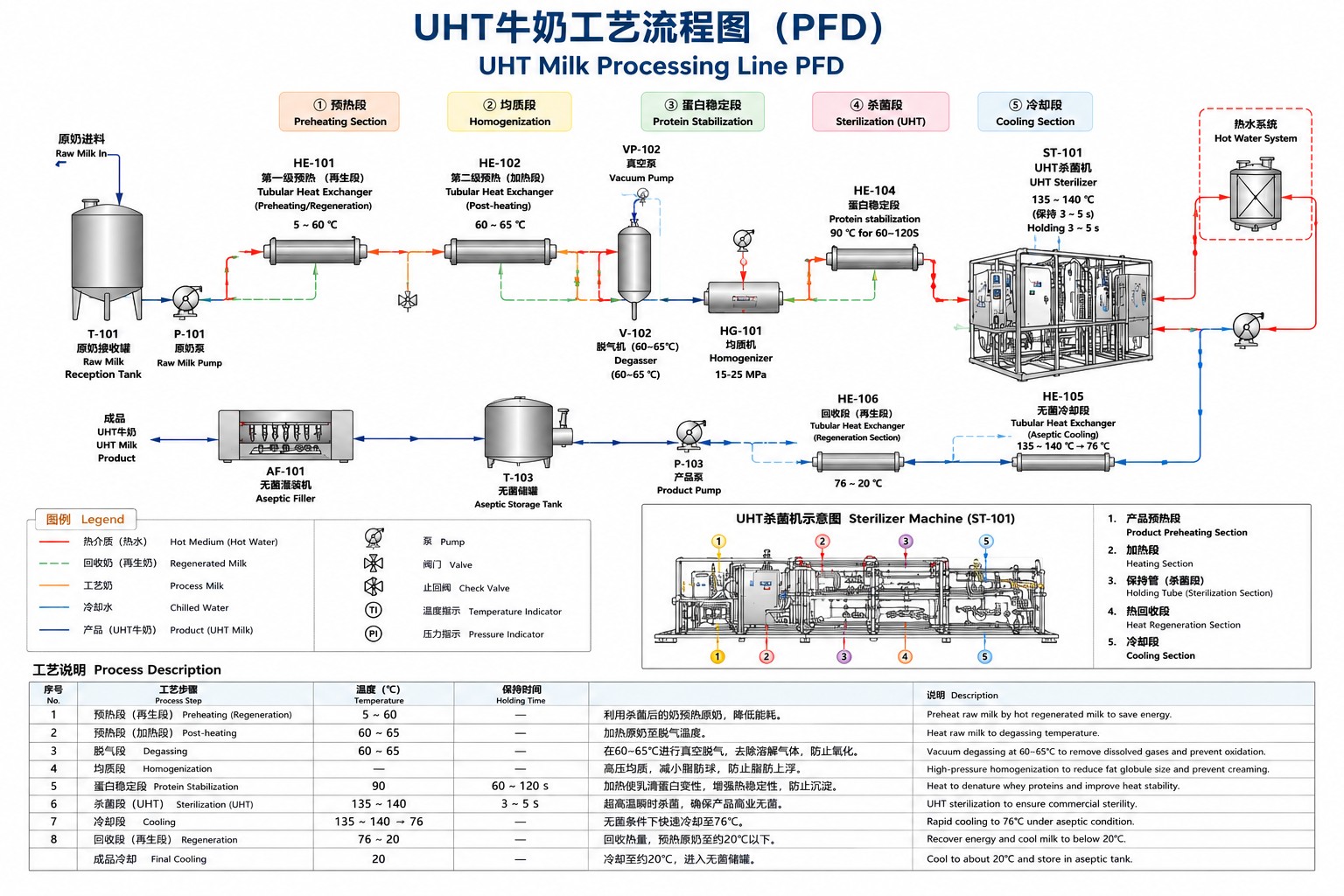
Typical Protein Stabilization Process Flow
A typical UHT milk processing line with protein stabilization includes the following steps:
1. Preheating Section
Before entering the protein stabilization section, milk is usually preheated through a tubular heat exchanger to 60–75°C
Main purposes:
- Reduce viscosity before homogenization
- Improve heat transfer efficiency
- Prepare proteins for controlled heat treatment
A gradual temperature increase is important because sudden heating may cause excessive protein denaturation.
2. Homogenization
Homogenization is typically carried out at a temperature of 60–75°C with a pressure range of 150–250 bar, depending on the product formulation and processing requirements.
The main purpose of homogenization is to reduce the size of fat globules and create a more uniform dispersion of fat throughout the milk. This process improves emulsion stability, enhances mouthfeel, prevents cream separation, and ensures a consistent product texture during storage.
The combination of protein stabilization and homogenization provides improved physical stability by optimizing both protein structure and fat dispersion, helping UHT milk maintain its quality, smooth texture, and stability throughout its shelf life.
3. Protein Stabilization Heating Section
The milk is heated to the protein stabilization temperature range, typically around 90°C, and held for 60–120 seconds under controlled conditions.
During this stage:
- Whey proteins undergo controlled partial denaturation.
- β-lactoglobulin interacts with κ-casein, improving the stability of the casein micelle structure.
- The protein system is modified to achieve better heat resistance during subsequent UHT sterilization.
The objective of protein stabilization is not to cause complete protein denaturation, but rather to achieve controlled structural modification that improves thermal stability while maintaining the desired quality, texture, and storage performance of the final product.
4. Holding Tube Design
The holding tube is a critical component of the protein stabilization section. The holding tube must ensure:
- Accurate residence time
- No short-circuit flow
- Uniform temperature distribution
The holding time is calculated according to:
- Product flow rate
- Pipe diameter
- Pipe length
- Temperature requirement
A standard UHT milk line may use 90°C holding for 60-120 seconds for protein stabilization. The exact design should be verified according to the customer’s milk formulation and production capacity.
5. Temperature Control System
Protein stability is highly sensitive to temperature variations; therefore, precise temperature control is essential during the stabilization process. The protein stabilization section is typically equipped with high-accuracy temperature sensors, automatic steam control valves, and PLC-based temperature regulation systems to ensure stable and consistent processing conditions.
The temperature control accuracy is usually maintained within ±0.5–1°C. Accurate temperature regulation helps achieve the desired level of protein modification while preventing quality issues. If the temperature is too low, the protein stabilization reaction may be insufficient, resulting in reduced heat stability and poorer storage performance. On the other hand, excessive temperature may cause over-denaturation and protein aggregation, leading to increased viscosity and potential negative effects on product texture.
6. Final UHT Sterilization
After stabilization and homogenization, milk enters the UHT sterilization section. Typical conditions: Indirect UHT:138–140°C for 2–10 seconds; Direct Steam Injection (DSI): 140–150°C for several seconds. The final sterilization step achieves commercial sterility while maintaining product quality.
We provide complete turnkey solutions for liquid food processing, including:
- UHT milk processing lines
- Dairy beverage production lines
- Plant-based milk processing lines
- Yogurt production lines
- Homogenization systems
- CIP cleaning systems
- Aseptic filling solutions
Our engineering team designs UHT processing systems according to:
- Product formulation
- Protein content
- Production capacity
- Shelf-life requirements
- Local market conditions
A well-designed protein stabilization process helps manufacturers achieve stable, high-quality products with excellent storage performance.