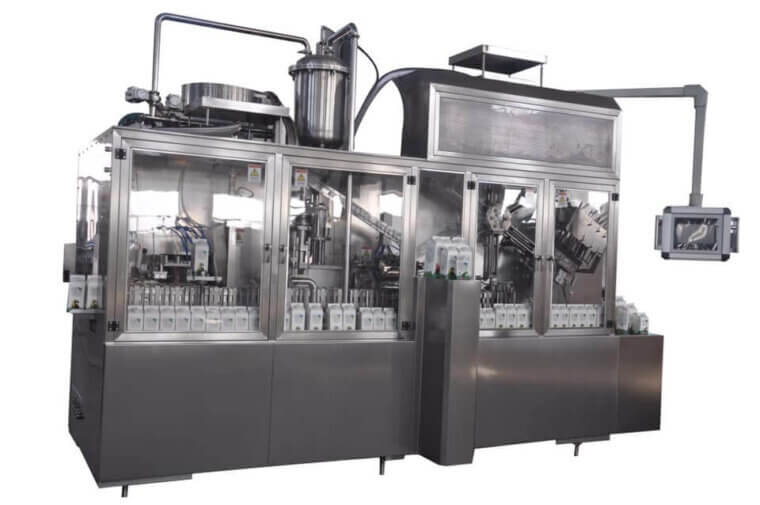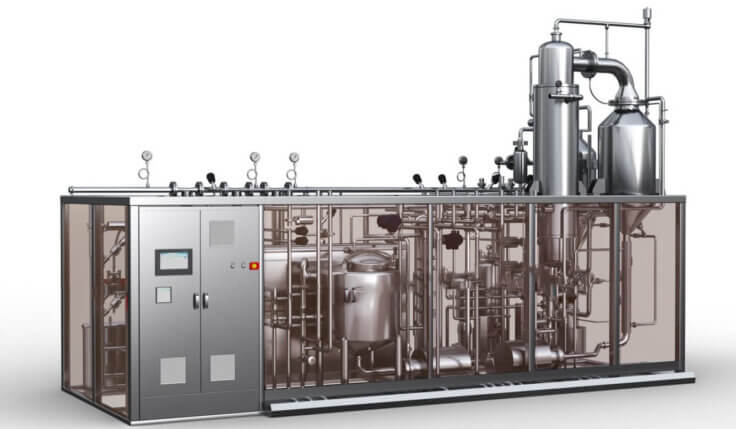
CIP Cleaning Station
CIP System General Description
CIP (Clean-In-Place) system is an automated cleaning technology that allows processing equipment, tanks, and pipelines to be cleaned without disassembly or manual removal. During the CIP process, heated cleaning solutions with controlled chemical concentrations are circulated through the equipment and pipelines to remove product residues, fats, grease, proteins, minerals, microorganisms, and other contaminants from surfaces that come into contact with the product.
As an efficient and reliable automatic cleaning solution, CIP systems enable safe and consistent cleaning while reducing manual operations and minimizing the risk of human error. Due to their advantages in hygiene control, cleaning efficiency, and production safety, CIP systems have become an essential part of modern food, beverage, dairy, and pharmaceutical production plants.
The main purpose of a CIP cleaning system is to remove product residues and microorganisms from processing equipment to prevent cross-contamination, maintain consistent product quality, and ensure the safety of finished products. By automatically controlling cleaning procedures, including water rinsing, alkaline cleaning, acid cleaning, and sanitation, CIP systems provide repeatable and effective cleaning performance.
CIP System Application Field
CIP systems are extensively used in food and beverage processing plants to clean tanks, pipes, filling equipment, and other processing machinery. Applications include cleaning and sanitizing equipment used for dairy processing, brewing, bottling, juice processing, and more.
Milk and Dairy Processing Industry: CIP systems clean and sanitize milking equipment, storage tanks, and processing equipment in milk and dairy farms and dairy processing plants. Efficient cleaning is essential to maintain the quality and safety of dairy products.
Juice and Beverage Processing Industry: It is used to clean and sanitize a variety of equipment and pipelines involved in juice processing, such as fruit and vegetable preparation machines, fruit juice and pulp-making machines, juice blending and pasteurizing/sterilizing system, juice filling and packing system.
Liquid Food Processing: When manufacturing fruit and vegetable sauce, bone broth, liquid egg products, dressings, and desserts, need CIP cleaning system to clean tanks, pipelines, heat exchangers, pasteurizers/sterilizers, and fillers.
Breweries and Distilleries Processing Industry: CIP systems are integral in breweries and distilleries for cleaning brewing kettles, fermenters, storage tanks, piping, and other equipment used in beer and spirits production.

CIP Cleaning System Type
1. Structural Type
- Integrated skid-mounted type
- Separate tank type
2. Heating Method
- Steam heating
- Electric heating
3. Control Mode
- Manual control
- Semi-automatic control
- Fully automatic control
4. Tank Configuration
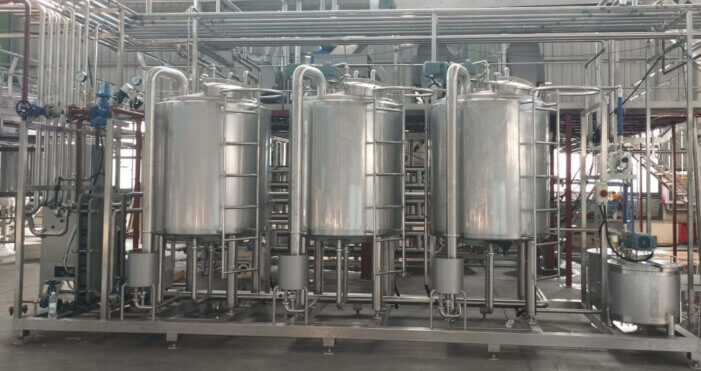
- Three-tank CIP system: Acid tank, alkaline tank, and hot water tank
- Four-tank CIP system: Acid tank, alkaline tank, hot water tank, and fresh water tank
- Five-tank CIP system: Acid tank, alkaline tank, hot water tank, rinse water tank, and circulating water tank
5. Cleaning Circuits / CIP Loops/CIP Pressure Lines
The CIP system can be designed with different cleaning circuits according to production capacity and the number of processing units requiring cleaning:
- Single circuit: suitable for smaller CIP systems (e.g., around 2,000 L CIP tanks)
- Double circuit: suitable for medium-capacity CIP systems (e.g., around 4,000 L CIP tanks)
- Three circuits: suitable for larger systems (e.g., around 6,000 L CIP tanks)
- Four circuits: suitable for high-capacity systems (e.g., around 8,000 L CIP tanks)
- Five circuits: suitable for large-scale processing plants (e.g., around 10,000 L CIP tanks)
The CIP system can also be customized with dedicated cleaning circuits according to the customer’s process requirements, including separate product lines, filling machines, tanks, pasteurizers, and UHT sterilizers.

Structure of CIP Cleaning System
—Cleaning Solution Tanks: These tanks hold the cleaning agents, such as detergents, sanitizers, and water. The solution is prepared according to the specific cleaning requirements of the equipment being cleaned, these cleaning tanks mainly include the following:
- Acid and Alkali tank: SUS316L, double layers and PU insulation thickness is 60mm, off-central agitator 36rpm, high/low-level meter, overflow port, bottom drain port, top concentrated acid and alkali dosing port, top return port, conductivity meter connector, sealed manhole, adjustable legs, side outlet, lifting lugs, sampling valve, digital show thermometer, volume from 500L-10000L.
- Hot water tank: SUS304, double layers with PU insulation, inner layer upper and lower head thickness3mm, out layer 2mm, and PU insulation thickness is 60mm, high/middle/low-level meter, temperature sensor, sealed manhole, adjustable legs, side outlet, lifting lugs, digital show thermometer, volume 500-10000L.
- Pure water tank: SUS304 stainless steel, single layer tank, high/middle/low level meter, sealed manhole, adjustable legs, side outlet, lifting lugs, digital show thermometer, volume 500-10000L.
- Circulating water tank: SUS304, double layers, high/middle/low level meter, sealed manhole, adjustable legs, side outlet, lifting lugs, digital show thermometer, volume 500-10000L.
–Heat Exchangers: The tubular or plate heat exchangers are used to heat the cleaning agent to 50-60℃.
–Pumps: Pumps are used to circulate the cleaning solution through the system at a controlled flow rate and pressure. They ensure that the cleaning solution reaches all the necessary areas and removes the contaminants effectively. The pumps include the CIP forwarding pump, CIP return pump and acid and alkali diaphragm pump.
–Spray Devices: Spray devices, such as spray balls or nozzles, are installed in the equipment or pipelines being cleaned. These devices distribute the cleaning solution throughout the surfaces, ensuring thorough cleaning and sanitization.
–Control System: CIP systems are typically controlled by a central control panel or programmable logic controller (PLC). The control system manages the operation of pumps, valves, and other components, allowing for automated and precise cleaning cycles. The PLC mainly controls various transmitters and converters for cleaning temperature, pressure, cleaning solution concentration, liquid level, flow rate, etc.
–Control Instruments and valves: Temperature control system – pointer pressure gauge; Flow control – vortex flow meter; flow switch; Temperature control – temperature sensor (tank and pipeline); Level control – level sensor; Concentration control – conductivity meter (tank and pipeline). The valves mainly include gate valves, filters, pressure reducing valves, regulating valves, angle seat valves, steam traps; sampling valves, check valves, welded butterfly valves, three-piece ball valves, pneumatic butterfly valves, pneumatic LL type seat valves, etc.
Features of CIP Cleaning System
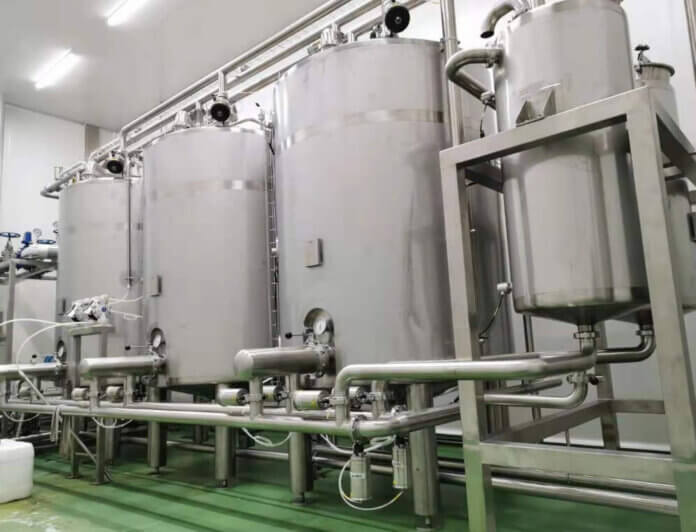
- The economic operating cost of the CIP cleaning system is low, the structure is compact, and the floor space is small. Installation and maintenance are convenient. The CIP cleaning system can effectively clean the production equipment such as tanks, machines and pipes. The entire cleaning process is in a full closed environment, which can avoid the chance of secondary pollution.
- The CIP system can be divided into one to four routes according to production needs. In particular, the second and above routes can not only clean the same area or two or more areas at the same time but also can clean while producing during the production process. This greatly shortens the CIP cleaning time during production.
- The CIP system uses a pneumatic diaphragm pump to pump concentrated acid and alkali, which not only improves the equipment intact rate and reduces the maintenance rate of the equipment, but also reduces the operating cost.
- Especially the fully automatic CIP, which can automatically detect, add liquid, discharge, display and adjust the cleaning liquid. It runs reliably, has a high degree of automation, simple operation and good cleaning effect, so it is more suitable for modern large-scale fluid medicine. Hygienic requirements and production environment requirements for food processing technology.
- Automatically switch various process parameters, and automatically adjust parameters such as cleaning time, PH, temperature, etc.
- All operations can be recorded to facilitate GMP certification.
- The CIP cleaning system has single-tank, double-tank and multi-tank systems for users to choose from. There are both mobile and fixed types.
- In a food and beverage processing plant, all the tanks, pipelines and equipment need to be cleaned daily to keep the whole production line sanitary.
- The main configuration of the system: automatic Siemens PLC control system and 12-inch color touch screen, British Spirax Sarco steam pressure reducing valve, Korea JK steam trap, German temperature detection and adjustment system, German JUMO or Anderson-Negele conductivity meter, German IFM flow switch.
- The whole system can realize automatic control of tank temperature and discharge temperature, automatic control acid and alkali concentration and compensation, automatic alarm of equipment failure to be cleaned, automatic control of liquid level in the tank, automatic switching of CIP process, and self-cleaning of the tank.

CIP System Cleaning Procedure
A properly designed CIP (Clean-in-Place) system ensures effective cleaning and sanitation of food and beverage processing equipment without disassembly. A typical CIP cycle consists of pre-rinsing, alkaline cleaning, intermediate rinsing, acid cleaning, and final sanitation.
1. Alkaline Cleaning
The equipment is first rinsed with hot water above 60℃ for 3–5 minutes to remove residual products. Then, a 1–2% alkaline cleaning solution heated to 60–80℃ is circulated through the equipment for 10–20 minutes to remove organic residues such as fat, protein, and other deposits.
After alkaline cleaning, the system is rinsed with purified water below 60℃ for 5–10 minutes to remove remaining chemical residues, followed by a final rinse with ambient-temperature purified water for 3–5 minutes.
2. Acid Cleaning and Sanitization
For removing mineral deposits and scale, an acid cleaning cycle is performed. The equipment is cleaned with a 1–2% acid solution at 60–80℃ for 5–10 minutes.
After acid cleaning, purified water below 60℃ is used for an intermediate rinse for 5–10 minutes. The final sanitation step uses 90℃ hot water for 10–20 minutes to reduce microbial contamination before production.
3. Cleaning Solution Management
CIP cleaning solutions can be recovered and reused multiple times. The concentration, temperature, and cleaning performance should be monitored regularly. The cleaning solutions should be replenished or replaced periodically(typically once a week) according to production requirements and the CIP management program.