Tomato Ketchup Production Line
Description of Tomato Ketchup Production Line
The tomato ketchup production line uses tomato paste (28–30°Brix or 36–38°Brix) as the main raw material, which is diluted with purified water and blended with ingredients such as sugar, salt, vinegar, starch, spices, and optional preservatives, followed by homogenization, degassing, pasteurization, hot filling at 85–89°C, secondary pasteurization and cooling before final packaging into bottles, cans, pouches, sachets, or cartons.
Tomato ketchup is a popular tomato-based condiment widely used in food industries. It is made from concentrated tomato paste with the addition of water, sugar, salt, vinegar, spices, and other ingredients. Tomatoes naturally contain nutrients such as lycopene, vitamins, minerals, organic acids, and dietary fiber, which contribute to the characteristic color, flavor, and nutritional value of ketchup products.
All ingredients are accurately dosed according to the product formulation through weighing systems, flow meters, or automated metering devices to ensure precise ingredient ratios, consistent product quality, and stable flavor, color, and texture in every tomato ketchup production batch.
The complete tomato ketchup production line consists of an RO water treatment system, hot water preparation system, tomato paste transfer system, ingredient dissolving system, ketchup preparation and mixing system, homogenization, degassing and pasteurization system, filling machine, secondary pasteurization and cooling system, and CIP cleaning system. The production line can be customized for either batch or continuous operation according to the customer’s production capacity, product requirements, and investment budget.
Tomato ketchup processing equipment is manufactured using food-grade SUS304/SUS316L stainless steel. After production, the CIP (Cleaning-In-Place) system automatically cleans the product pipelines, storage tanks, pumps, filling machines, and pasteurization equipment to maintain high hygiene standards and ensure consistent product quality between batches.
The ketchup production process involves blending the concentrated tomato paste with water, vinegar, sugar, salt, and spices, heating the mixture to dissolve the solids and reduce it to a desired consistency, filtering out any remaining impurities, bottling or canning the ketchup, and finally, pasteurizing it to ensure safety and longevity on shelves as a popular condiment for various food dishes.
The capacity of the tomato ketchup production line ranges from 500 L/h to 5000 L/h, providing flexible options to meet different production requirements and investment plans.
The final products from the tomato sauce or ketchup processing plant can be packaged in various formats, including plastic bottles, tubes, tin cans, pouches, sachets, and glass jars, according to the customer’s packaging requirements.

Ketchup Ingredients Formula For Reference
| Ingredients | Percentage |
|---|---|
| Sterilize RO Water | 38% |
| Concentrated Tomato Paste | 30% |
| Liquid Glouse | 13.5% |
| Sugar | 12% |
| Fine Salt | 3% |
| Vinegar | 2% |
| Starch | 1% |
| Flavours and Sweeteners | 0.3% |
| Sodium Erythorbate | 0.2% |
Technological Flowchart For Tomato ketchup Production Line:
There are two main types of tomato ketchup processing lines available according to production capacity and investment requirements:
1. Continuous Production Tomato Ketchup Processing Line
The continuous tomato ketchup production line is suitable for medium and large-scale industrial production requiring stable and efficient operation. The main raw materials, including tomato paste, sugar, water, and other ingredients, are accurately dosed and continuously mixed in the blending system. The prepared ketchup mixture then passes through homogenization, degassing, pasteurization, and filling processes before being packed into various small packages, such as bottles, sachets, pouches, or cartons.

2. Batch Production Tomato Ketchup Processing Line
The batch tomato ketchup production line is suitable for small-scale production with limited investment budgets, generally for capacities below 1 ton/hour. In this system, tomato paste, water, sugar, and other ingredients are added into a vacuum mixing/cooking tank according to the recipe.
The multifunctional vacuum processing tank integrates several processes, including ingredient mixing, heating, pasteurization, homogenization/emulsification, degassing, and cooling. After processing, the finished tomato sauce or ketchup is transferred to a buffer tank and then filled into small packages.
This batch system provides a cost-effective solution for manufacturers requiring flexible production capacity and lower initial investment.

Key Machine of Tomato Sauce or ketchup Production Line
Tomato paste transfer system
The tomato paste transfer system is mainly used to transfer concentrated tomato paste from aseptic bags packed in drums to the blending tank. The system typically consists of an electronic weighing scale, pneumatic piston pump, electric hoist, and sanitary pipelines. The electric hoist is used for lifting and positioning the aseptic bag, while the weighing system ensures accurate measurement of tomato paste quantity during transfer. The pneumatic piston pump provides gentle and reliable transfer of high-viscosity tomato paste while maintaining product quality and hygiene. All product-contact parts are made of food-grade stainless steel to meet sanitary processing requirements.
Tomato ketchup ingredients dissolving system
The tomato ketchup ingredients dissolving system is used to prepare a uniform solution of powder ingredients such as sugar, salt, starch, and other dry additives before the ketchup blending process. The system mainly consists of a high-shear dissolving tank, sanitary transfer pump, and double filtration system.
During operation, 85℃ hot water is first added into the high-shear dissolving tank. The powder ingredients are accurately weighed according to the recipe and added into the tank manually or fully automatically. The high-speed agitator generates strong circulation and shear forces to rapidly disperse, hydrate, and dissolve the ingredients, ensuring a uniform solution.
After complete dissolution, the ingredient solution is transferred by the sanitary pump through the double filter system, which removes undissolved particles and impurities. The filtered solution is then pumped into the ketchup blending tank for further processing.

Tomato ketchup blending tank
The blending and preparation process is the core stage of tomato ketchup production, where tomato paste, water, sugar, salt, vinegar, and other ingredients are uniformly mixed according to the product recipe to form the ketchup base. The blending process can be carried out under heated conditions, which improves ingredient dissolution, mixing efficiency, and product consistency. The processing temperature is typically controlled at around 50–65°C, and the mixing time is adjusted according to the formulation and production requirements.
The tomato ketchup blending tank is manufactured with a double-layer insulation tank or three-layer jacketed structure using food-grade stainless steel SUS304 or SUS316L for product-contact parts. It is equipped with a paddle-type agitator with an adjustable speed range of 0–65 rpm, providing gentle and uniform mixing of tomato paste, water, sugar, and other ingredients.
The tank is equipped with essential components including a product inlet and outlet, sanitary manhole, PT100 temperature sensor, steam heating system, level sensor, CIP spray ball, sanitary valves, and other accessories.
According to different production requirements, the blending tank can be designed as a vacuum mixing and pasteurization tank for batch ketchup production. This integrated design combines mixing, heating, pasteurization, and cooling functions in one unit, helping customers reduce equipment investment and simplify the production process.

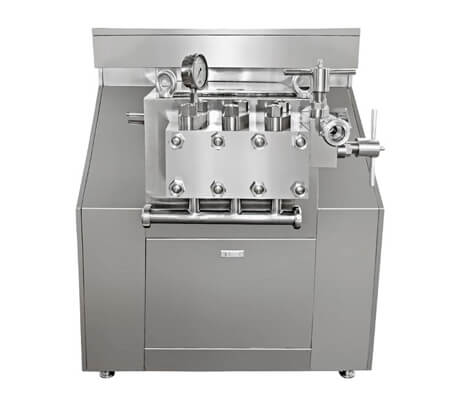
Tomato ketchup high-Pressure homogenizer
The high-pressure homogenizer is an advanced emulsification and dispersion device used to improve the texture and stability of tomato ketchup. Under the combined effects of high shear force, turbulence, cavitation, and impact, the homogenizer reduces particle size, improves the uniform distribution of tomato solids, and produces a smoother and more stable ketchup texture.
After homogenization, tomato ketchup has a finer particle structure, improved mouthfeel, and enhanced viscosity stability. The homogenization process also helps prevent phase separation and improves the overall product quality.
Due to the high viscosity, high solids content, and acidic characteristics of tomato ketchup, the homogenizing valve and components are subject to higher wear during operation. Therefore, a two-stage homogenization system is often recommended for ketchup processing to achieve better dispersion performance and more stable product quality.
A high-pressure homogenizer mainly consists of a high-pressure pump and homogenizing valve assembly. For tomato ketchup processing, the homogenizing pressure is typically controlled within the range of 25–40 MPa, depending on the product formulation and required texture.
Tomato ketchup degasser and inline pasteurizer
Before pasteurization, tomato ketchup is usually transferred into a vacuum degassing tank to remove entrapped air and dissolved oxygen from the product. Degassing helps reduce oxidation, maintain the natural color and flavor of ketchup, prevent air bubbles during filling, and improve product stability. The degassing process is typically carried out at around 55–60°C under vacuum conditions.
After degassing and homogenization, the tomato ketchup is pumped into the pasteurization system for thermal treatment. The pasteurization process reduces spoilage microorganisms and ensures product safety while extending shelf life. A typical inline ketchup pasteurization process includes preheating, homogenization, high-temperature holding, and cooling before hot filling. The pasteurization temperature is usually controlled at 90–95°C with a holding time of approximately 30–120 seconds, depending on the product pH, soluble solids content (Brix), viscosity, packaging type, and shelf-life requirements. After pasteurization, the ketchup is cooled to around 85°C for hot filling.
Due to the high viscosity and high solids content of tomato ketchup, conventional plate heat exchangers are generally not suitable. Instead, tube-in-tube heat exchangers or scraped-surface heat exchangers are commonly used for continuous inline ketchup pasteurization. These systems provide efficient heat transfer through indirect heating and cooling using hot water and cooling water as heat exchange mediums, while minimizing product fouling and maintaining product quality.

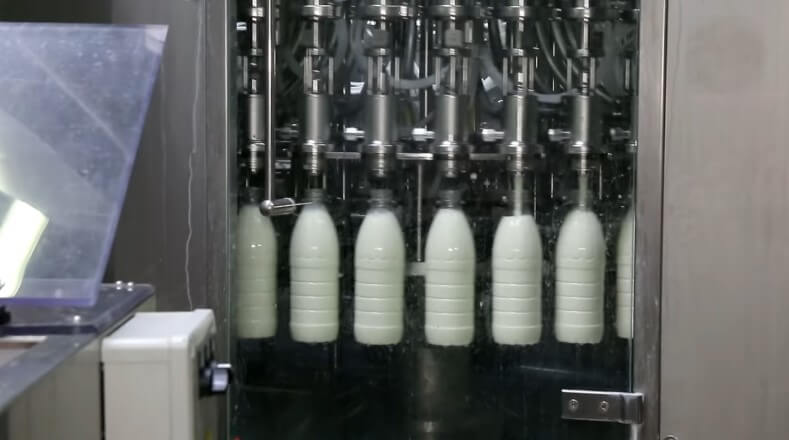
Tomato sauce or ketchup filling machine
After homogenization, degassing, and pasteurization, the tomato sauce or ketchup should have a uniform bright red color, smooth texture, stable consistency, and natural tomato flavor and aroma. The finished product can then be filled into various packaging formats, including 10–100 g four-side-sealed sachets, 70 g–2.5 kg tin cans, 100 ml–2500 ml PET or glass bottles, and stand-up pouches.
The ketchup filling machine is typically a piston-type filling machine, which provides high filling accuracy and reliable performance for thick and viscous products such as tomato ketchup. According to different production capacities, packaging formats, and customer requirements, the filling system can be configured with different numbers of filling heads and automation levels to achieve efficient and hygienic ketchup packaging.
Tomato sauce or ketchup pasteurizing and cooling machine
After hot filling, some tomato ketchup products require secondary pasteurization to further improve product safety and extend shelf life. According to different packaging formats, two types of pasteurization and cooling systems are commonly used.
For tomato ketchup packed in tin cans, glass bottles, or plastic bottles, a spray-type pasteurization and cooling tunnel is commonly applied. The containers pass through different temperature zones where hot water is sprayed onto the package surface to gradually heat the product inside. After pasteurization, cooling water is sprayed to reduce the product temperature to ambient conditions.
For tomato ketchup packed in stand-up pouches, doypacks, or sachets, a water bath pasteurization and cooling machine is recommended. The flexible packages are immersed in hot water to achieve uniform heat transfer and pasteurization. After thermal treatment, the packages are cooled through cold-water zones and then dried by compressed air to remove water droplets from the surface before final packaging.
A typical pasteurization and cooling process includes:
- Hot water heating zone at approximately 90–95°C
- Warm water pre-cooling zone
- Cooling water zone to reduce the product temperature to near room temperature
The complete process usually takes around 40–60 minutes, depending on the package size, product characteristics, filling temperature, and required pasteurization conditions.

CIP cleaning plant
The tomato ketchup processing plant requires a CIP (Cleaning-In-Place) system to regularly clean and sanitize tanks, pipelines, pumps, valves, filling machines, and other processing equipment. A properly designed CIP system helps maintain high hygienic standards, prevent contamination between batches, and ensure consistent product quality.
Normally, the processing equipment is cleaned after each production shift or production cycle. The cleaning solutions can be recovered and reused through circulation, while their concentration and cleaning performance should be monitored regularly. When the chemical concentration decreases or the cleaning efficiency is reduced, the cleaning solution should be replaced or replenished according to the production requirements.
The capacity of the CIP cleaning system depends on the number of cleaning circuits, the size and volume of equipment, the length of pipelines, and the ketchup production capacity. The system is designed to provide sufficient cleaning flow, temperature, and chemical concentration to achieve effective cleaning.
A complete tomato ketchup CIP system mainly consists of:
- Acid tank
- Alkali tank
- Hot water tank
- Cleaning water/recovery water tank (optional)
- Plate or tubular heat exchanger for heating cleaning solutions
- CIP supply and return pumps
- Sanitary pipelines and valves
- Control system

RO water treatment system for ketchup production plant
The RO water treatment system is used to produce purified water for ketchup production, including ingredient dissolving, product mixing, and CIP cleaning. Using high-quality RO water helps maintain consistent product quality, improve hygiene, and reduce the risk of contamination.
The RO water system capacity is designed according to the ketchup production capacity and process requirements. It mainly consists of a raw water tank, sand filter, activated carbon filter, RO unit, and optional UV or ozone sterilization system.