High-Pressure Homogenizer
Function and Application
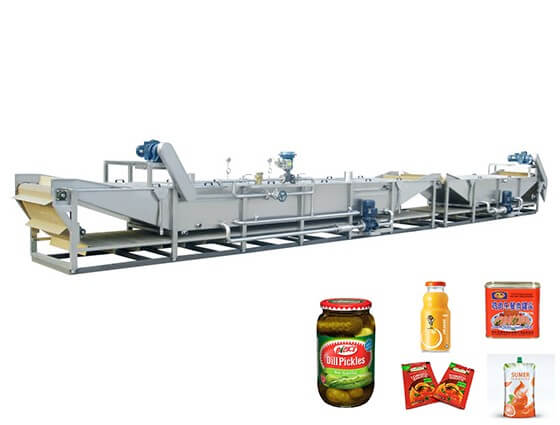
High-pressure homogenizers are widely used in the dairy, fruit juice/pulp, beverage, sauce, and plant-based milk industries. By applying high pressure and mechanical forces, these machines reduce particle size, improve dispersion, and enhance product uniformity and stability.
1. Ice Cream and Dairy Desserts (Recommended homogenization pressure: 10–25 MPa)
High-pressure homogenization reduces fat globule size and improves the dispersion of fat and other ingredients in ice cream mixes. This helps improve emulsion stability, texture, creaminess, and overall product quality. The actual pressure depends on the formulation, fat content, homogenization temperature, and required texture.
2. Fruit Juice and Fruit Puree(Recommended homogenization pressure: 10–25 MPa)
In fruit juice and puree production, homogenization reduces the size of suspended particles and improves the uniformity of the product. It can help reduce phase separation and sedimentation, improve mouthfeel, and maintain a more consistent appearance. The optimal pressure depends on the fruit variety, pulp content, viscosity, and desired product characteristics.
3. Milk and Dairy Products(Recommended homogenization pressure: 15–25 MPa)
During milk homogenization, the liquid passes through a narrow homogenizing valve under high pressure. The resulting shear forces, impact forces, and cavitation effects reduce fat globule size and improve fat dispersion.
This process helps prevent cream separation, improves emulsion stability, and contributes to a uniform appearance and smooth mouthfeel. Homogenization is commonly performed at approximately 55–75°C, depending on the product and process configuration. One- or two-stage homogenization may be selected according to the required product stability and processing conditions.
4. Fruit Juice Beverages and Pulp-Based Drinks(Recommended homogenization pressure: 15–30 MPa)
High-pressure homogenization is suitable for many fruit juice beverages, nectar drinks, and pulp-containing beverages. It reduces particle size, improves the dispersion of pulp and other suspended solids, and can help improve physical stability and mouthfeel.
For products containing pectin or other stabilizing ingredients, homogenization can improve their distribution throughout the liquid. However, the effectiveness of homogenization in preventing sedimentation depends on the formulation, particle characteristics, viscosity, and stabilizer system.
5. Plant-Based Milk(Recommended homogenization pressure: 20–40 MPa)
High-pressure homogenization is widely used in the production of soy milk, oat milk, almond milk, coconut milk beverages, and other plant-based drinks. It reduces the size of oil droplets and suspended particles, improves dispersion, and helps reduce creaming and sedimentation.
The appropriate pressure depends on the raw materials, solids content, fat content, viscosity, and desired texture. Additional processing, such as heat treatment or enzymatic treatment, may be required depending on the product formulation.
6. Sauces and Liquid Food Products(Recommended homogenization pressure: 25–40 MPa)
In the production of sauces, dressings, emulsified condiments, and other liquid food products, homogenization helps disperse oil droplets and fine particles, improve product uniformity, and enhance emulsion stability.
The operating pressure must be selected according to the product’s viscosity, particle size, oil content, and required texture. Products containing large solid particles or highly viscous materials may require specialized equipment or alternative mixing and emulsification systems.
Note: The pressures listed above are preliminary selection ranges rather than fixed operating specifications. The optimal homogenization pressure should be determined through product trials and validated process requirements. Pressure requirements may differ between single-stage and two-stage homogenization systems.
Working Principle
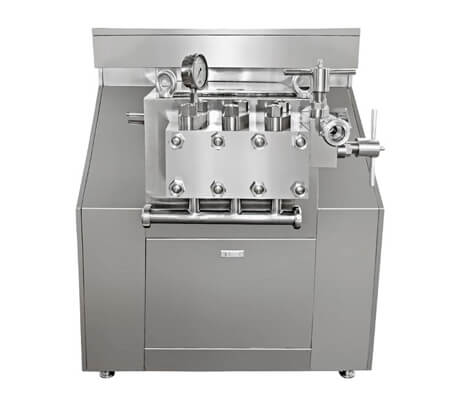
GJJ series high-pressure homogenizer is used to homogenize and emulsify liquid materials (liquid-liquid phase or liquid-solid phase) with a viscosity lower than 0.2Pa.s and temperature lower than 80℃.
The working principle is that processed material will be sent to the homogenization valve in the form of high pressure through the reciprocating motion of the three plungers so that the instantaneous flow of material through the small gap between the valve disc and the valve seat is subject to turbulence, cavitation, shear With the effect of cutting and other compound forces, the original rough emulsion or suspension is processed into a very fine, uniform and stable liquid-liquid mixed emulsion or liquid-solid dispersion.
Its average emulsification fineness is below 1um, solid the dispersed particle size below 2um on average. After the material is homogenized by a high-pressure homogenizer, it has many advantages: it has extremely high stability, can improve storage quality, speed up reaction time, and save additives; it can be used in food, health care products, cosmetics and other fields to improve the absorption quality of the human body.
Structure&Material
Power end:
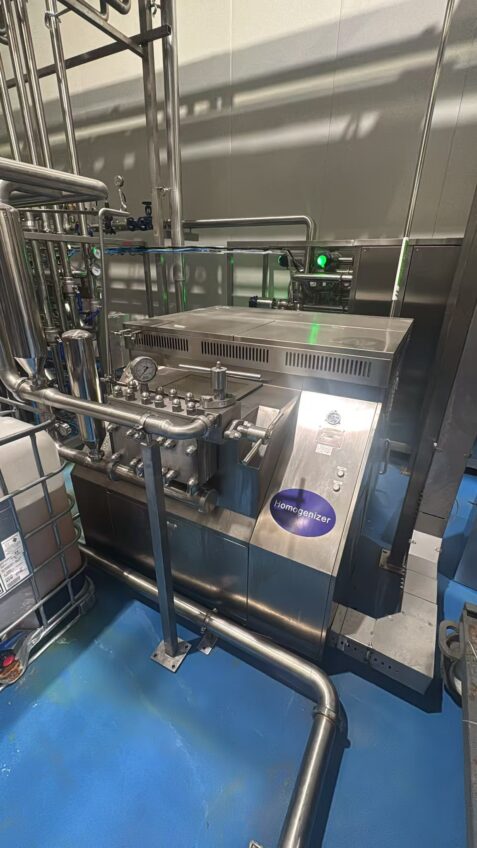
- Drive: Using Siemens motor, two-stage speed change; one-stage pulley, two-stage crank arm gear symmetrical transmission; special alloy bearing bush, double-sided rolling bearing, horizontal stable and low noise. High mechanical efficiency.
- Lubrication: splash-free lubrication.
Liquid end:
- Main pump body: three-way type, the gland adopts radial self-sealing, which is durable and has no leakage.
- Plungers: 3 plungers, the new connection method with the piston adopts a nut transition shaft and a three-piece clamp set. Durable, safe, easy to disassemble and assemble. Square mixing plunger seal assembly.
- One-way valve: 3 sets each of poppet valve inlet and outlet, 6 sets in total. Durable and reliable, ensuring flow rate ≥ rated flow value.
- Homogeneous valve: A three-piece set (high-pressure valve core, seat, collision ring) flat valve is installed for the first-level high pressure, and a two-piece flat valve is installed for the second-level low pressure.
- Pressure monitoring: Diaphragm pressure gauge imported from Germany.
- Pressure regulation: step-less manual pressure regulation device (one set each for high and low-pressure handwheels).
Machine material:
- Drive assembly: box body HT20-40, crankshaft, connecting rod and gear made of special alloy ductile iron, crankshaft QT600-3 selected after three-step flaw detection, suitable for low-speed and heavy-load operation. The crankshaft, piston rod, and special alloy bearings are all non-replaceable parts for life (normal lubrication).
- Plunger: fourth-generation special steel (PH type), reaching the international advanced level.
- One-way valve: Fourth generation special steel (PH type), wear-resistant and impact-resistant, superior to Stellite and reaching the international advanced level.
- Pump body and valve body: 1Cr18Ni9Ti stainless steel, hexahedral forging and forming, will not crack. Suitable for high-pressure operation and has long service life.
- Seal: fourth-generation sealing material, high-temperature resistance 100℃.
- Homogeneous valve: The valve core is made of third-generation special alloy. Good hardness, toughness and durability.
- Inlet and outlet pipe: 304 stainless steel.
- The above materials are non-toxic, pollution-free, acid and alkali resistant, and suitable for CIP cleaning.

Description
- The whole machine is covered with a stainless steel shell, and the appearance is smooth and exquisite, safe and hygienic.
- Adopt helical gear low-speed transmission, low noise, stable operation and reliable performance.
- The transmission part adopts splash type and unique oil delivery method to ensure the lubrication needs of each part.
- The double-sided design of the valve seat can double the service life.
- Homogeneous valve, one-way valve and plunger are made of alloy steel, which has the characteristics of wear resistance, impact resistance and long service life.
- Depending on the processing of different products, it can be equipped with one stage homogenizing head or double-stage homogenizing head.
- Usually, the homogenizer is placed in the upstream section of the final heating of the heat exchanger, such as in the production of pasteurized milk or non-sterile juice, the homogenizer is placed in the position where following the first heat recovery stage. When processing the aseptic products, the homogenizer is usually equipped in the downstream area of the heating system, this type of homogenizer requires an aseptic design with aseptic plunger seals, packaging, aseptic condensers and a special aseptic baffle.
Technical Parameter
| Model | Capacity | Max. Pressure | Working Pressure | Power | Size |
|---|---|---|---|---|---|
| GJJ-0.2/25 | 200L/H | 20/40/60mpa | 20/35/60mpa | 2.2/3/5.5kw | 755*520*935mm |
| GJJ-0.5/25 | 500L/H | 25/40/60mpa | 20/35/60mpa | 4/7.5/11kw | 1010*616*975mm |
| GJJ-1/25 | 1000L/H | 25/40/60mpa | 20/35/60mpa | 7.5/15/22kw | 1100*676*975mm |
| GJJ-1.5/25 | 1500L/H | 25/40/60mpa | 20/35/50mpa | 11/22/37kw | 1100*770*1100mm |
| GJJ-2/25 | 2000L/H | 25/40/70mpa | 20/35/60mpa | 15/30/45kw | 1410*850*1190mm |
| GJJ-3/25 | 3000L/H | 25/40/70mpa | 20/35/60mpa | 22/45/75kw | 1410*960*1280mm |
| GJJ-4/25 | 4000L/H | 25/40/60mpa | 20/35/50mpa | 30/55/90kw | 1550*1050*1380mm |
| GJJ-5/25 | 5000L/H | 25/40/60mpa | 20/35/50mpa | 37/75/115kw | 1605*1200*1585mm |
| GJJ-6/25 | 6000L/H | 25/40mpa | 20/35mpa | 45/90kw | 1671*1260*1420mm |
| GJJ-8/25 | 8000L/H | 30/40mpa | 25/35mpa | 55/110kw | 1671*1260*1420mm |
| GJJ-10/25 | 10000L/H | 30/40mpa | 20/35mpa | 75/132kw | 2725*1398*1320mm |
| GJJ-12/25 | 12000L/H | 25/40mpa | 20/35mpa | 90/132kw | 2825*1500*1320mm |