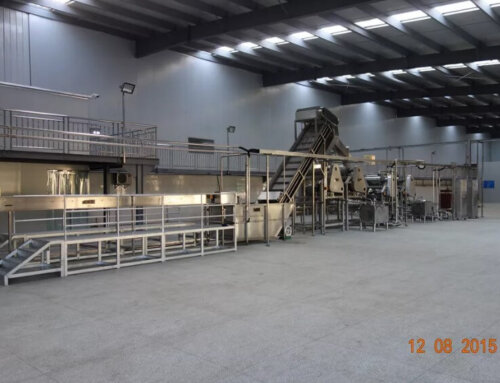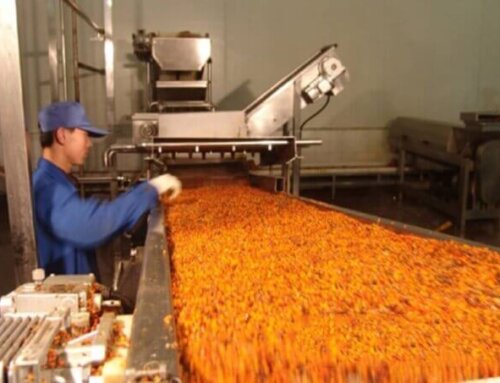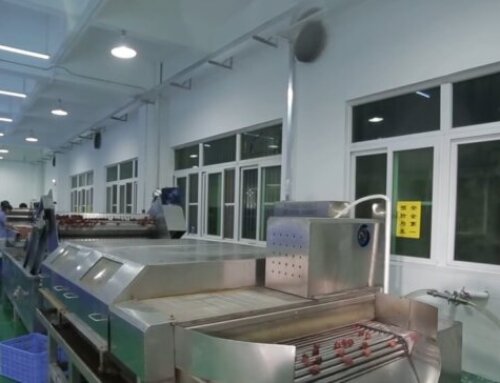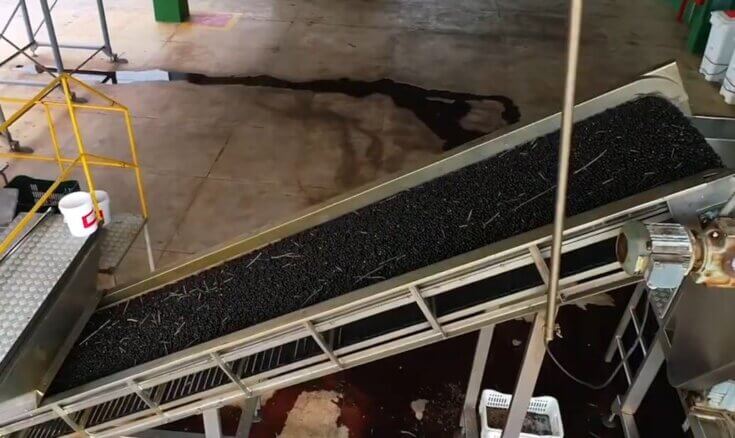
Mango Processing Line
The Characteristic Of The Mango Processing Line
- A complete mango processing line consists of a series of machines designed to process fresh mangoes into various value-added products, including mango pulp, mango puree, mango juice, mango concentrate, frozen mango pulp, and dried mango products.
- The main equipment includes mango washing and sorting machines, mango peeling and destoning machines, mango cutting machines, mango pulping machines, mango pulp refining and separation equipment, concentration systems, pasteurizers or sterilizers, aseptic filling machines, and packaging machines.
- The typical mango production process starts with fresh mango receiving, washing, and sorting to remove impurities and defective fruits. The cleaned mangoes then go through peeling, destoning, and pulping processes to produce smooth mango pulp. Depending on the final product requirements, the mango pulp can be further refined, concentrated, pasteurized/sterilized, and packed into different packaging formats.
- The complete mango processing line can be customized based on raw material conditions, final product specifications, and packaging methods. Production capacity ranges from 10 tons/day to 500 tons/day of fresh mango processing, suitable for small, medium, and large-scale mango processing factories.
- The mango processing line can achieve a mango pulp yield of approximately 55–75%, depending on the mango variety, maturity level, and processing method. The remaining 25–45% mainly consists of mango peel, seed/core, and processing waste. The fresh mango raw material typically has a soluble solids content of 10–12 °Brix. After concentration, the mango juice concentrate can reach approximately 55–65 °Brix, while concentrated mango puree is usually processed to 28–30 °Brix according to customer product requirements.
- The complete mango processing line features high efficiency, automation, and flexibility, enabling large-scale processing of fresh mangoes with reduced labor requirements, shorter processing time, and consistent product quality. The entire production process is controlled by a PLC automatic control system, ensuring stable operation and precise process management. All key electrical components are selected from internationally recognized brands to improve equipment reliability, durability, and long-term performance.
- The complete mango processing plant is equipped with an automatic CIP (Clean-in-Place) cleaning system, which can fully clean production equipment, tanks, and pipelines without disassembly. All product-contact parts of the processing system are manufactured from food-grade SUS304 stainless steel, ensuring excellent corrosion resistance, hygiene, and compliance with food safety requirements. The CIP system helps maintain stable product quality, improve cleaning efficiency, and reduce manual cleaning labor.
The End Products and Packaging Containers:
—Concentrated mango pulp/puree filled into aseptic bags in drums or bag in box containers.
—Non-concentrated mango pulp/puree filled into aseptic bags in drums, bag in box containers or metal cans
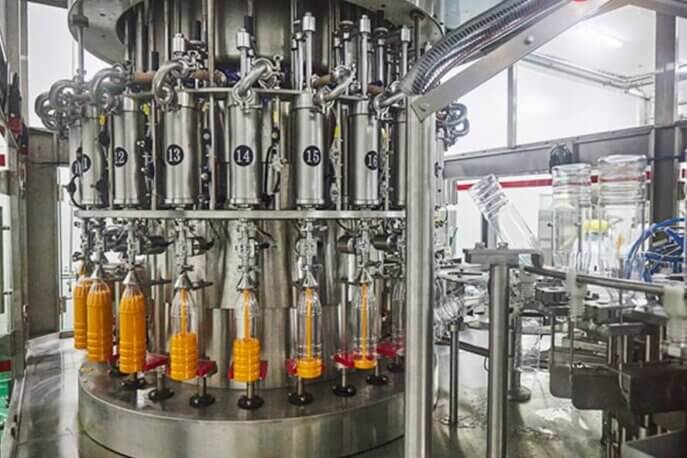
—Blended mango juice filled into PET/glass bottles, small tin cans, tetra paks, cartons, or other small containers.
—NFC mango juice filled into PET/glass bottles, aseptic cartons.
—Dry Mango chips/slices filled into pouches or jars.

The Processing Flowchart Of The Mango Processing Line
Concentrated mango pulp/puree processing flowchart:
Fresh mango after washing, sorting, destoning and peeling, pulping, filtering, evaporating, sterilizing, then filled into 220kg aseptic bags in drums. The end products of concentrated mango pulp technical parameters are Brix 28-30% or 30-32%, PH value is 3.0-4.0.
Non-concentrated mango pulp/puree processing flowchart:
Fresh mango after washing, sorting, destoning and peeling, pulping, filtering, standardizing, homogenizing, vacuum degassing, sterilizing, then filled into 220kg aseptic bags in drums. The end products of non-concentrated mango pulp/puree technical parameters are that Brix value is 14-22%, Total acidity: 0.3-1.1%, PH:3.2-4.0, Pulp content:≥40%.
Blended mango nectar/juice processing flowchart:
Concentrated mango puree/juice is used as raw materials; after blending with water and sugar and other additives, homogenizing and degassing, and sterilizing, the end mango juice is filled into PET/glass bottles, small tin cans, and aseptic cartons.
NFC mango nectar processing flowchart:
Fresh mango after washing, sorting, destoning and peeling, pulping, filtering, decanter centrifuge, disk separating, homogenizing, degassing, sterilizing, then filled into small bottles; the filler is usually for aseptic filling.
Dry mango chips/slice processing flowchart:
The mango is washed, peeled, sliced, and dried to make dried mango slices. It takes 20-30 hours to complete drying for each batch of fresh mangoes. The moisture of fresh mango slices is between 80%-85%. After being dried by a heat pump dryer, the moisture of dried mango slices is about 10%-12%. The heat pump drying is completed in 5 stages: the first stage is 55℃, which is the heating stage; the second stage is 60℃, the dehumidification stage; the third stage is 62℃, the continuous dehumidification stage; the fourth stage is 58℃, cooling and dehumidifying; and the last stage is 55℃, consolidating and dehumidifying.
The Scheme of concentrated and non-concentrated mango pulp/puree processing line

The Scheme of mango juice/nectar processing line:

Key Machine of Mango Processing Line
Fresh mango ripen chamber
Fresh mango fruits will be stored in a ripen chamber to ripe mango to 80%-90% maturity after harvest, the ripen chamber temperature needs to be controlled at 18-24℃, and humidity between 90%-95%, it may also add ethylene gas to accelerate the ripening process. The mango after ripening, will be more easy to separate mango pulp from mango peel and mango stone in the mango pitting and peeling process.
Mango fruit washing and sorting machine
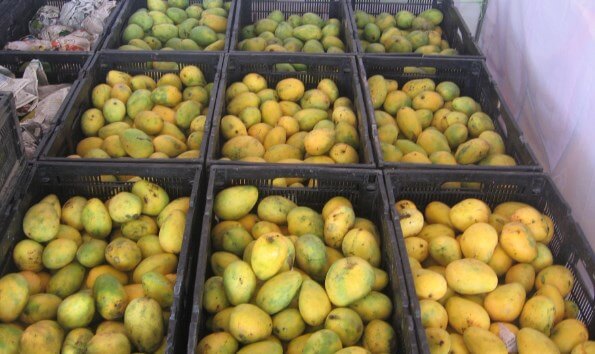
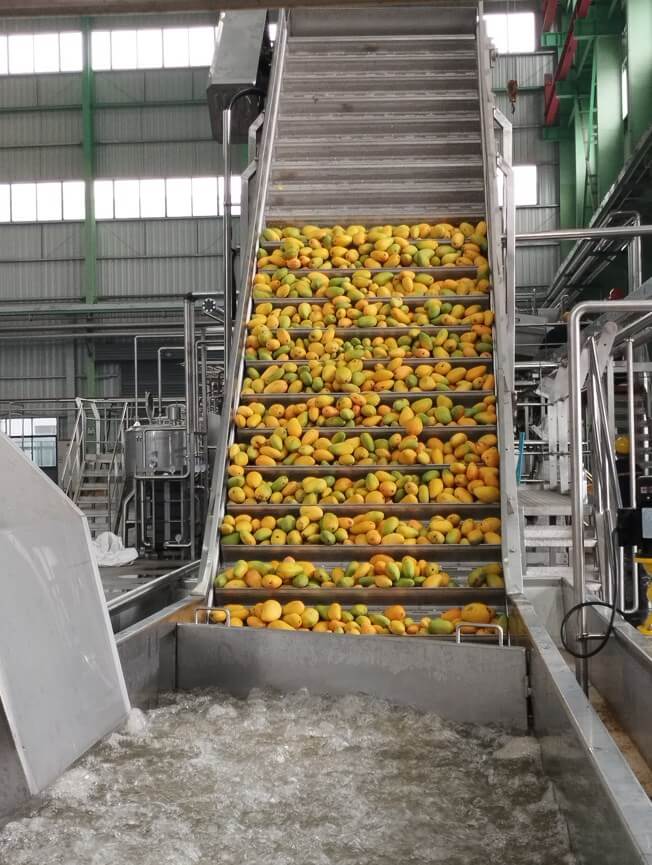
After harvesting, fresh mangoes usually contain soil, dust, leaves, and other surface impurities. In a mango processing line, the fresh mangoes are first transferred to an air-blowing washing machine and brush washing machine for effective cleaning. The air bubbles and rotating brushes gently remove dirt and foreign materials from the mango surface while minimizing fruit damage.
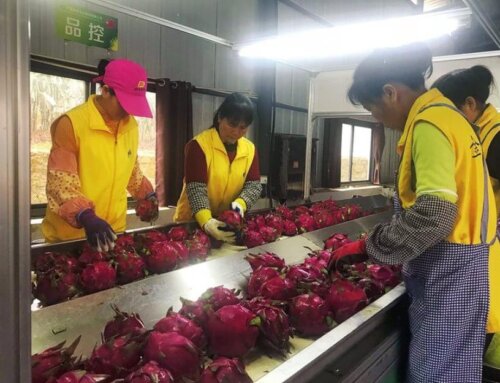
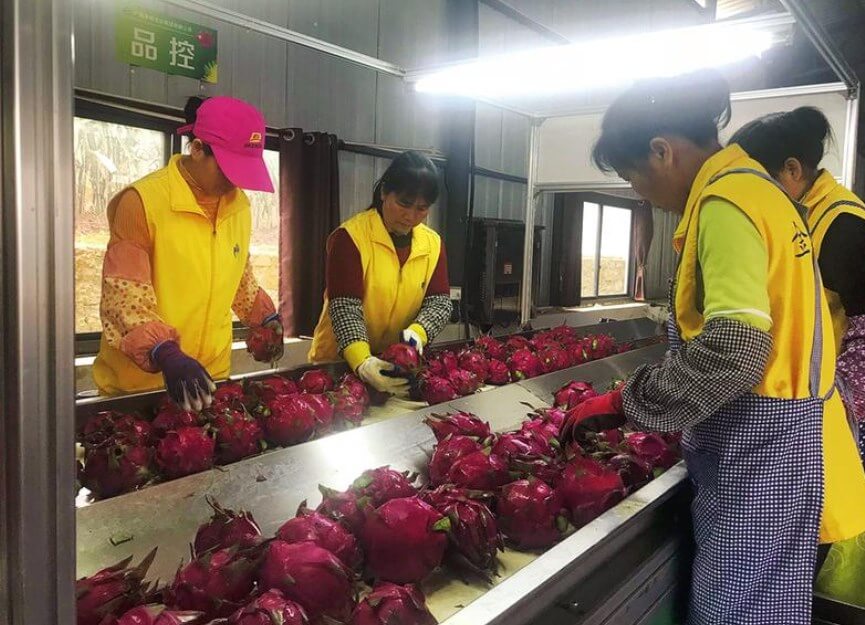
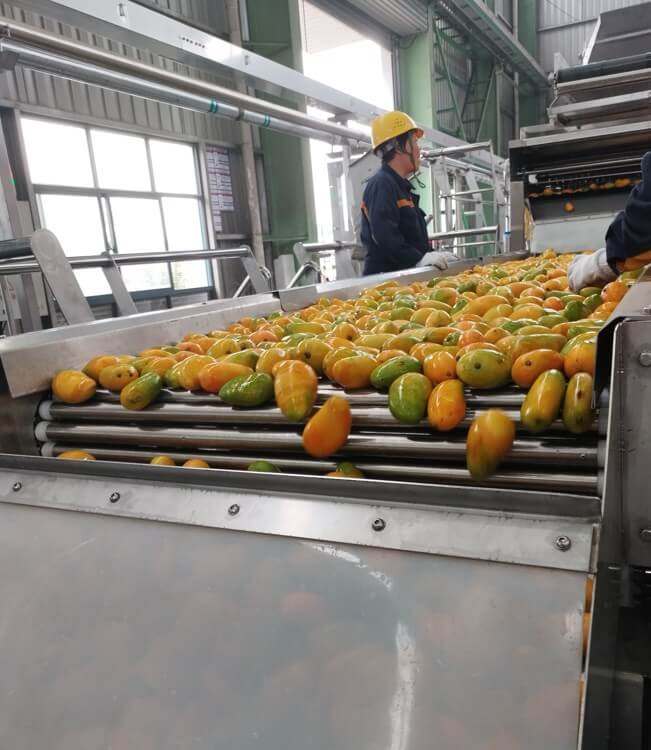
After washing, the cleaned mangoes are conveyed by an elevator to the manual mango sorting machine. The sorting conveyor is designed to allow up to 6 operators to work simultaneously, enabling workers to inspect the mangoes and remove rotten, damaged, or unqualified fruits. This manual sorting process helps ensure only high-quality mangoes enter the next stage of processing, such as mango peeling, pulping, juice extraction, or puree production.
Mango fruit pre-cooking machine
The mango pre-cooking machine, also called a mango blanching machine, uses 65–95℃ hot water blanching technology to soften mangoes, improve pulp yield, and make peeling easier. The blanching temperature and time can be adjusted according to the mango maturity level.
Made of SUS304 stainless steel, the machine is hygienic, durable, and suitable for continuous mango processing. The capacity is 1–5 tons per hour, widely used in mango juice, puree, and concentrate production lines.

Mango destoning and peeling machine
The mango peeling and destoning machine is mainly used for separating pre-cooked mangoes, removing mango stones, and recovering high-quality pulp. The system consists of two main units: fruit-breaking device and crushing & destoning device.
The fruit-breaking device gently crushes pre-cooked mangoes between two plum-shaped rollers to reduce the pressure during the destoning process. The adjustable roller gap (20–40 mm) helps protect mango stones from damage.
The crushing and destoning unit uses a high-speed scraper to separate mango pulp from the stone. The pulp passes through a customized sieve, while the mango stones are automatically discharged. The motor speed can be adjusted by frequency control according to different mango varieties and maturity levels, ensuring efficient pulp recovery.


Mango Pulping machine
The double stage mango pulping machine is designed to process mango mash into high-quality mango pulp or puree. It separates mango peels, seeds, and coarse fibers from the pulp while refining the puree to improve product quality and pulp recovery.
The machine is equipped with two pulping stages: the first-stage sieve with Φ1.2 mm mesh and the second-stage sieve with Φ0.4-0.6 mm mesh, ensuring efficient extraction of smooth mango puree with higher yield.
For small-scale mango processing plants (0.5–2 tons/hour), a mango peeling, destoning, and pulping machine can be used. This integrated machine combines mango peeling, stone removal, and pulp extraction functions in one unit, reducing equipment investment and saving production space.

Mango pulp decanter centrifuge separator
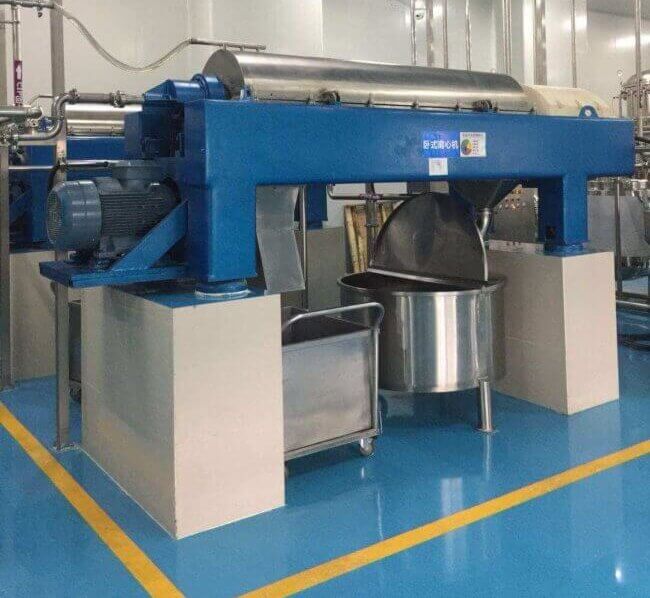
The mango pulp decanter centrifuge separator is mainly used to remove specks, coarse fibers, insoluble particles, and fine solid impurities from mango pulp and puree, improving the smoothness and quality of the final product.
During operation, mango puree enters the rotating bowl of the decanter centrifuge. Under high-speed centrifugal force, the solid particles are separated from the liquid pulp according to their density difference. The screw conveyor continuously discharges the separated solids, while the refined mango puree is collected for further processing.
The machine is equipped with frequency control, allowing flexible adjustment of operating speed according to different mango varieties, pulp viscosity, and solid content. With bowl diameters ranging from 250 mm to 720 mm, it can meet different capacity requirements in mango juice and puree processing plants.
Mango pulp standardized system
In a single-strength mango pulp processing plant, different mango varieties may have different natural Brix values. To ensure consistent product quality, the mango pulp needs to be standardized by adjusting the soluble solids content through controlled addition of ingredients, such as RO water or sugar solution, according to the final product requirements.
The mango pulp standardization system includes a sugar and ingredient dissolving system, RO water metering system, and mango pulp blending tanks. The system ensures accurate mixing and uniform product quality before further processing or aseptic filling.
After standardization, the final mango pulp Brix value can be monitored through an online pipeline refractometer or checked by a sampling valve installed on the blending tank.

Mango Pulp/Juice Concentration and sterilizing machine
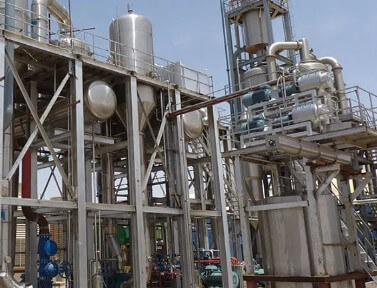
After pulping and refining, the mango pulp is transferred by a screw pump to a forced circulation evaporator for concentration. The evaporator uses vacuum and multi-effect evaporation technology to remove water at a lower temperature, reducing energy consumption while preserving the natural color, flavor, and nutrients of mango.
The forced circulation evaporator is especially suitable for high-viscosity mango puree due to its fast product circulation, reduced residence time, and excellent heat transfer performance. It can produce 28–30 °Brix concentrated mango puree or 55–65 °Brix mango juice concentrate according to customer requirements.
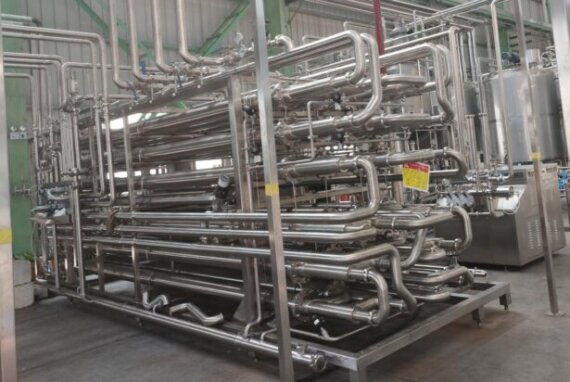
Due to the high viscosity of concentrated mango puree, a tube-in-tube sterilizer is used for heat treatment before aseptic filling or other packaging methods. The sterilization system provides precise control of temperature and holding time to ensure product safety and consistent quality.
The typical sterilization condition for mango puree is 105–115℃ with a holding time of 30–60 seconds. The exact parameters can be adjusted according to the mango puree Brix value, viscosity, pH, filling method, and required shelf life.
Mango pulp/puree/juice filling machine
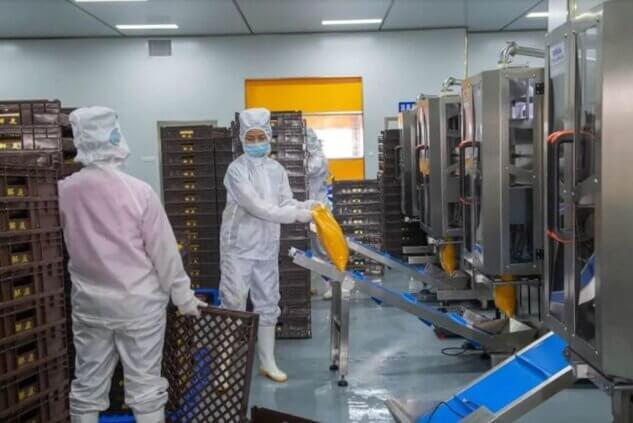
—For concentrated mango puree, we provide single-head or double-head aseptic filling machines to fill the product into 220 kg aseptic bags placed in drums. The filling capacity ranges from 1 to 5 tons per hour.
The aseptic filler adopts a fully sanitary design with CIP cleaning function. The mango puree filling process is controlled by a high-precision flowmeter to ensure accurate filling volume. The filling chamber is sterilized by steam before production to maintain aseptic conditions and ensure long shelf life. Properly processed aseptic mango puree can achieve a shelf life of approximately 18–24 months under suitable storage conditions.
—For single-strength mango pulp (non-concentrated mango pulp), different packaging solutions are available, including:
- 3–10 kg bag-in-box packaging
- 220 L aseptic bags
- 350 g–3 kg tinplate cans
—For mango juice and mango nectar, the products are usually filled into consumer-size packages, including:
- PET bottles
- Aseptic cartons
- Metal cans
Hot filling technology is suitable for bottles, pouches, and cans, while aseptic filling technology is commonly used for aseptic cartons and products requiring extended shelf life. Available filling volumes typically range from 250 ml to 5 L