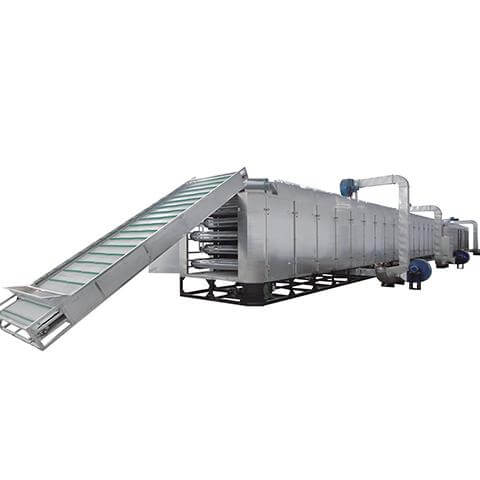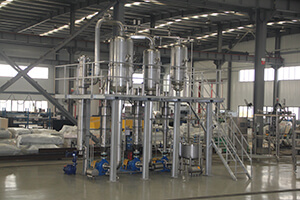
Forced Circulation Evaporator
Application Range of Forced Circulation Evaporator
The Forced Circulation Evaporator is specifically designed for concentrating products with high viscosity, high solids content, suspended particles, or a strong fouling tendency. By continuously circulating the product through the heat exchanger at high velocity, the system ensures efficient heat transfer, minimizes scaling, and provides stable, continuous operation for demanding food processing applications. In the liquid food and beverage field, the evaporator is mainly used for the following material concentrations:
- Fruit puree concentration (mango puree, banana puree, apple puree, pumpkin puree, carrot puree, tomato paste)
- Meat and poultry products (bone broth, chicken broth, beef broth, pork broth, meat extract, chicken extract)
- Gelatin and collagen processing (gelatin solution, collagen extraction liquor, collagen peptide feedstock)
- Dairy products (whey concentrate, milk concentrate, lactose solution)
- Plant protein products (soy protein extract, pea protein extract, oat extract, rice protein liquor)
- Starch and grain processing (corn steep liquor, potato protein liquor, wheat protein liquor)
- Sugar and sweetener production (glucose syrup, fructose syrup, maltose syrup, molasses)
- Seasonings and flavorings (yeast extract, mushroom extract, vegetable extract, soy sauce concentrate)
- Seafood processing (fish broth, shrimp extract, seafood extract)
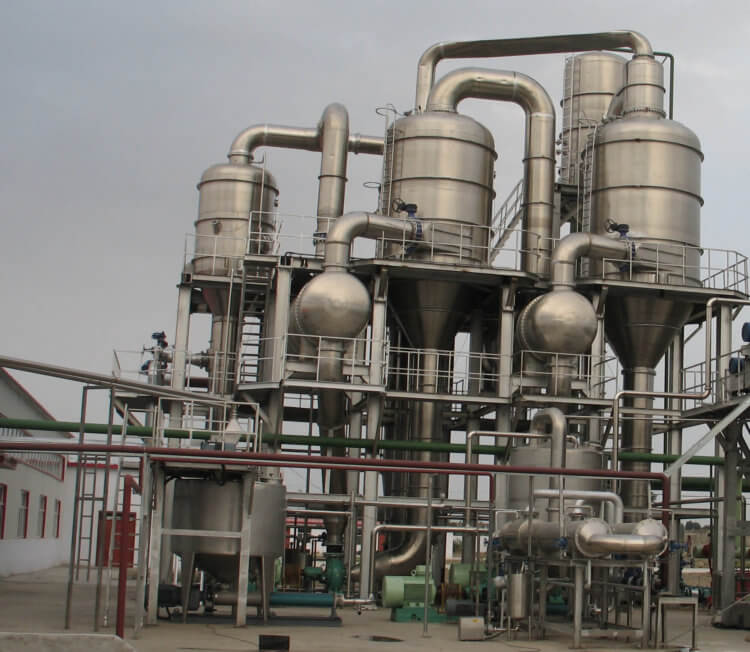
Forced Circulation Evaporator Composition
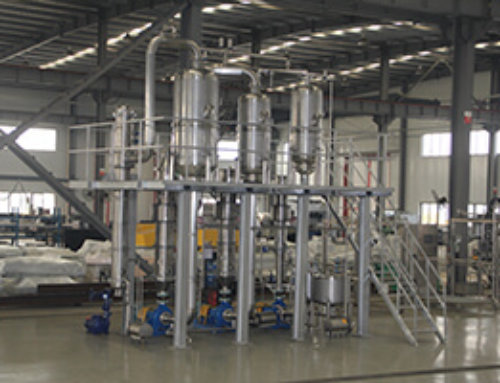
This equipment consists of multi-effect heater exchangers, separators, condensers, vacuum pumps, balance tank, material feeding pump, material discharge pump, vacuum pumps, electric control boxes, and all pipes and valves:
- Heat exchanger: This is the main component of the evaporator, and it is responsible for transferring heat to the liquid being evaporated.
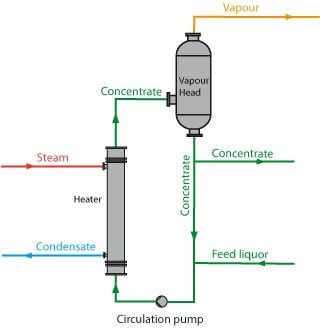
- Circulation pump: The circulation pump is used to circulate the liquid through the heat exchanger at a high velocity, allowing for efficient heat transfer and evaporation.
- Separator: The separator is used to separate the vapor generated during the evaporation process from the liquid being evaporated.
- Condenser: The condenser is used to condense the vapor generated during the evaporation process back into a liquid form, which can be recycled or disposed of.
- Vacuum system: The vacuum system is used to maintain a low pressure inside the evaporator, which reduces the boiling point of the liquid being evaporated and allows for more efficient evaporation.
- Control system: The control system is used to monitor and control various parameters, such as temperature, pressure, and flow rate, to ensure optimal performance of the evaporator.
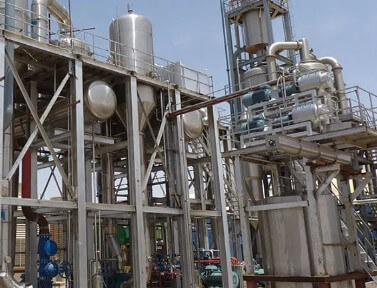
Forced Circulation Evaporator Feature
1. Hygienic Design and High-Quality Materials
All product-contact parts of the evaporator are manufactured from food-grade SUS304 or SUS316L stainless steel, ensuring corrosion resistance, durability, and compliance with food processing hygiene requirements.
The equipment frame is made of carbon steel with a protective coating to provide sufficient mechanical strength and long-term stability.
2. Efficient Heat Recovery and Energy Saving
The multi-effect evaporator adopts advanced heat recovery technology to maximize energy utilization.
The secondary vapor generated from the first-effect evaporator is reused as the heating medium for the second-effect evaporator. The secondary vapor generated from the second effect is then condensed through the condenser.
By reusing evaporation energy between effects, the system significantly reduces:
- Fresh steam consumption
- Cooling water consumption
- Overall operating costs
3. Condensate Heat Recovery System
The condensate generated from the heating chambers contains residual sensible heat.
Through optimized condensate recovery design, the heat energy from condensate water can be reused within the evaporation system, improving overall thermal efficiency and reducing energy waste.
4. Low-Temperature Vacuum Concentration
The entire evaporation process operates under vacuum conditions, which reduces the boiling temperature of the product.
Low-temperature evaporation provides several benefits:
- Minimizes thermal degradation
- Reduces scaling and fouling
- Preserves product color, flavor, and nutrients
It is especially suitable for concentrating heat-sensitive products such as:
- Fruit juice
- Vegetable juice
- Herbal extracts
- Pharmaceutical extracts
- Other temperature-sensitive liquid products
5. High-Efficiency Insulation Design
The heating chambers and evaporator bodies are equipped with thermal insulation layers.
Polyurethane foam insulation and stainless steel outer cladding with matte surface finishing are used to minimize heat loss and improve energy efficiency.
The entire process of heating, evaporation, and concentration is carried out in a fully enclosed sanitary environment.
6. High Concentration Capability and Stable Product Quality
The evaporator provides high evaporation capacity and concentration efficiency, allowing products to reach the required solids content with shorter processing time.
The controlled vacuum evaporation process helps maintain stable product quality and reduces unnecessary thermal exposure.
7. Premium Components and Reliable Operation
High-quality components from internationally recognized manufacturers can be selected according to customer requirements, including:
- Rotor pump: Durrex
- Steam control valves: Spirax Sarco
- Level sensors: Yokogawa
- Online Brix refractometer: Maselli
- PLC system: Siemens
- Frequency inverter: Danfoss
- Touch screen: Schneider
The use of reliable components ensures stable operation, long service life, and easy maintenance.
8. Fully Automatic PLC Control System
The entire evaporation system is controlled by an advanced PLC automation system.
The operator can monitor and adjust key process parameters through the touch screen, including:
- Product temperature
- Steam pressure
- Vacuum level
- Liquid level
- Concentration value (Brix)
The system uses PID control technology to achieve:
- Accurate temperature regulation
- Stable vacuum control
- Precise concentration control
- Reliable continuous operation
9. Automatic CIP Cleaning System
The evaporator is equipped with an integrated Clean-in-Place (CIP) system, allowing automatic cleaning of internal surfaces without dismantling equipment.
The CIP system ensures:
- High hygiene standards
- Reduced cleaning time
- Improved production efficiency
- Compliance with food processing requirements
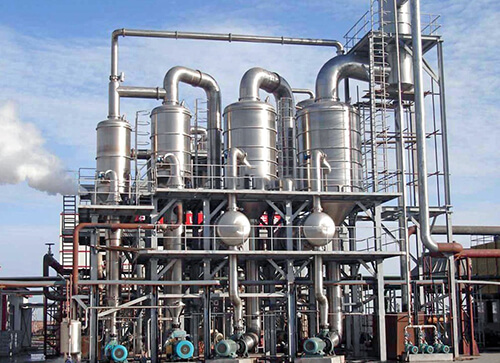
Forced Circulation Evaporator Working Process
The primary steam(boil steam) enters the one-effect heating chamber to heat the material liquid, the material forms a certain pressure difference between the heating chamber and the separation chamber. Under this action, the material continuously rises from the bottom of the heating chamber to the top, and finally spray into the one-effect evaporate chamber through one effect separator. The nozzle at the top sprays into the one-effect evaporation chamber and the material liquid flows back from the curve at the bottom of the evaporation separation chamber to the bottom of the heating chamber. After being heated again, it is sprayed into the evaporation chamber tangentially through the nozzle at the top of the one-effect heating chamber to form a cycle. The secondary steam is separated from the material in the rotating motion. After the material liquid is heated, it is sprayed into the evaporation chamber through a nozzle, and the water is quickly evaporated, and the material is continuously heated and evaporated. The secondary vapor that evaporates in a vacuum is in a vacuum. Under the action, it quickly enters the second-effect heating chamber to heat the second-effect material liquid, and the secondary steam evaporated by the second-effect enters the shell of the preheater and the condenser cooler, and the cooling circulating water enters the tube of the condenser cooler, and cools from the condensation. The top of the tube comes out of the tube and can be returned to the cooling tower. After passing through the cooling tower, it enters the cooling pool to form a cycle. The secondary steam is condensed into water in the condensing cooler and enters the condensate pump. The need to use a collection place, or to the whole plant or recycled into the cooling tower.
Technical Parameter
| Model | Single effect | Double effect | Triple effect | Forth effect | Fifth effect | ||||
|---|---|---|---|---|---|---|---|---|---|
| Evaporating temperature | 45-90 ℃ | ||||||||
| Steam consumption | Depend on the capacity and evaporating temperature of the material | ||||||||
| Steam pressure | 0.5-0.8MPA | ||||||||
| Material discharge brix | Depend on the material character | ||||||||
| Material Feeding brix | Depend on the material character | ||||||||
| Capacity(LPH) | 300-2000LPH | 1200-4000LPH | 3000-15000LPH | 8000-50000LPH | 10000-100000LPH | ||||