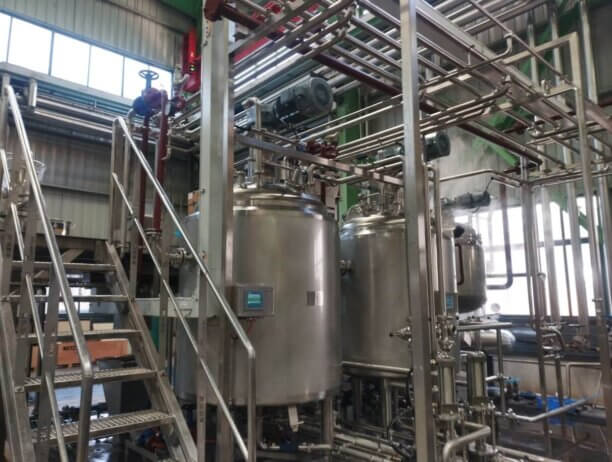
Can One UHT Sterilizer Be Shared Between UHT Milk and Pudding Milk? A Real Engineering Case Study
When designing a dairy processing plant, one of the most common requests from customers is to maximize equipment utilization while minimizing capital investment. A frequently asked question is:
Can one Tubular UHT Sterilizer process multiple dairy products with different viscosities, capacities and filling methods?
Recently, our engineering team evaluated a project involving three different dairy products. At first glance, sharing one UHT system appeared to be an ideal solution. However, after a comprehensive engineering assessment, we concluded that sharing a single UHT system was not the optimal solution.
This article explains the engineering considerations behind that recommendation.
Project Background
Recently, we evaluated a project with the following production requirements from one customer:
| Parameter | UHT Milk | Pudding Milk | ESL Milk |
|---|---|---|---|
| Capacity | 8000L/H | 4000L/H | 8000L/H |
| Viscossity | 30cP | 600cP | 30cP |
| Inlet Temperature | 25-30℃ | 60-70℃ | 25-30℃ |
| Sterilizing Temperature&Holding Time | 138℃ for 3-5S | 120℃ for 30S | 120℃ for 5S |
| Outlet Temperature | 25℃ | 86-90℃ | 4℃ |
| Filling Method | Aseptic filling into brick cartons | Hot filling into Thermo forming cups | Cold filling into brick cartons |
| Flow Regime | Turbulent | Laminar | Turbulent |
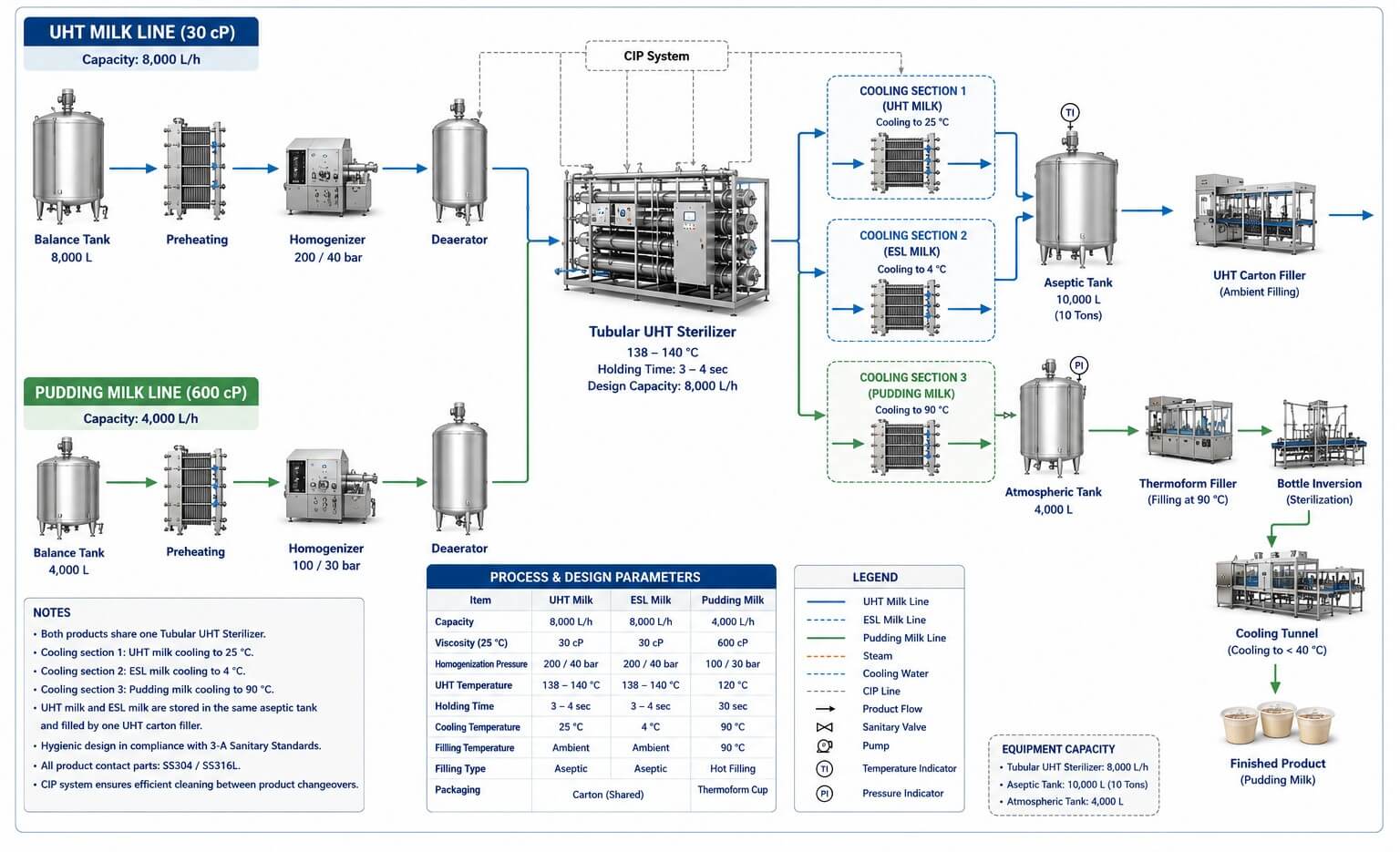
Based on the customer’s understanding, all three products—UHT milk, ESL milk, and pudding milk—are dairy products with relatively similar production capacities. Therefore, they believed that a single Tubular UHT sterilizer could be shared across all three production lines, reducing both equipment investment and plant footprint.
This assumption is understandable. In the dairy industry, Tubular UHT systems are widely used to process a broad range of liquid dairy products with different formulations and viscosities, including:
- White milk
- Flavored milk
- High-protein milk
- Milk shakes
- Dairy beverages
- High-viscosity dairy products
From an equipment capability perspective, a properly designed Tubular UHT system can indeed handle products with varying viscosities. Therefore, many customers naturally conclude that one UHT sterilizer should be capable of processing all three products.
Why Did Our Process Engineer Recommend Against It?
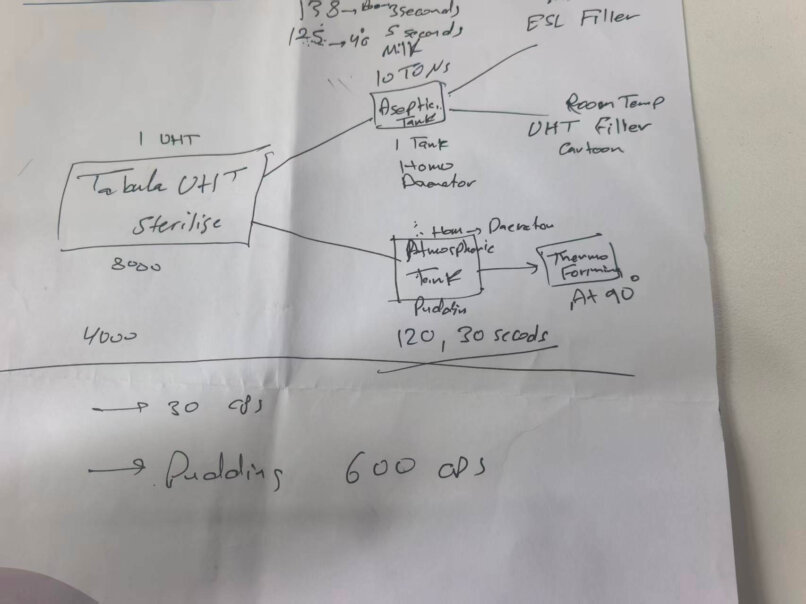
After our engineer has checked the customer requirements carefully, the engineer’s suggestion is to separate the UHT sterilizer for UHT milk and pudding milk, because equipment capability alone is not sufficient to determine whether multiple products should share one UHT system. A complete engineering evaluation must also consider product rheology, production capacity, sterilization validation, cooling requirements, filling technology, production scheduling, and long-term operational efficiency.
Engineering Challenge 1: Different Product Viscosities and Product Rheology.
In a UHT system, every particle of product must remain at the sterilization temperature for at least the validated holding time.
For example:
- 137–140°C
- Holding time: 4 seconds
However, this 4-second requirement refers to the minimum residence time, not the average residence time.
Different Viscosities Mean Different Flow Behavior
Milk with a viscosity of approximately 30 cP flows very differently from pudding milk at 600 cP.
Low-viscosity milk is much more likely to exhibit turbulent flow, resulting in a relatively uniform residence time distribution.
High-viscosity pudding milk tends toward laminar flow, where:
- Fluid near the pipe center travels faster.
- Fluid near the pipe wall travels slower.
As a result, residence time distribution becomes significantly wider.
Although the average holding time may remain the same, the minimum residence time changes, which directly affects sterilization validation.
The viscosity difference between UHT milk and pudding is approximately 20 times.
This significantly affects:
- Pressure drop
- Heat transfer coefficient
- Product velocity
- Reynolds number
- Residence Time Distribution (RTD)
Engineering Challenge 2: Different Production Capacities
The production capacity creates another major engineering challenge.
In this project:
- UHT Milk&ESL Milk = 8,000 L/h
- Pudding Milk = 4,000 L/h
The holding tube, product pumps and flow control are normally validated at the design flow rate.
When production is reduced from 8,000 L/h to 4,000 L/h:
- Product velocity decreases.
- Reynolds number decreases.
- Flow regime changes.
- Residence time increases.
- RTD changes.
This means the sterilization validation established for 8,000 L/h cannot simply be applied to 4,000 L/h production, even though we are equipped with a frequency converter on the UHT system.
In other words, changing production capacity is not merely changing pump speed—it changes the entire hydraulic behavior of the UHT system.
Engineering Challenge 3: Three Completely Different Cooling Processes
Although all three products are sterilized using the same Tubular UHT system, they require three completely different cooling profiles after sterilization.
- UHT Milk: Sterilized at 138–140°C, then cooled to 25°C before entering the 10,000 L aseptic tank for ambient carton filling.
- ESL Milk: Sterilized at 121°C, then cooled to 4°C before entering the same 10,000 L aseptic tank for chilled filling.
- Pudding Milk: Sterilized at 125°C, then cooled to 90°C before being transferred to a 4,000 L atmospheric tank for thermoform hot filling.
Although these products share the same UHT sterilizer, the downstream cooling systems must be designed to achieve three different target temperatures while maintaining stable process control.
This requires separate engineering considerations for:
- Heat recovery and energy balance
- Cooling medium selection and cooling capacity
- Heat exchanger sizing and thermal performance
- Automatic temperature control
- Product routing and valve sequencing
- PLC control logic and recipe management
As a result, the process configuration becomes significantly more complex than simply sharing one sterilizer. In practice, the cooling section and downstream process often become the limiting factors rather than the UHT sterilizer itself.
Engineering Challenge 4: Different Filling Technologies
The filling system has a direct impact on sterilization validation.
- UHT Milk
After UHT sterilization, the product enters an aseptic tank before being filled into cartons at ambient temperature.
There is no additional heat treatment after filling.
Therefore, the microbiological safety of the final product depends entirely on the validated UHT process.
- ESL Milk
ESL milk is cooled to approximately 4°C before filling.
Although the shelf life is shorter than UHT milk, strict hygienic processing and temperature control remain essential.
- Pudding Milk
Pudding milk is filled at approximately 90°C into thermoformed cups.
The hot filling process provides additional microbial control during packaging.
Consequently, the validation philosophy differs significantly from aseptic processing.
One shared UHT therefore needs to satisfy three different downstream processing concepts, greatly increasing engineering complexity.
Engineering Challenge 5: Frequent Product Changeovers
To minimize cleaning frequency and maximize operating efficiency, dairy plants typically organize production in campaigns rather than switching products several times a day. A typical production schedule for this project might be:
- Week 1: UHT Milk
- Week 2: ESL Milk
- Week 3: Pudding Milk
Although this production strategy reduces the number of product changeovers, every transition between products still requires a complete changeover procedure, including:
- Product recovery
- Water displacement
- CIP (Cleaning-in-Place)
- SIP (Sterilization-in-Place)
- Process validation and production restart
Depending on the plant design and production volume, each changeover may require 60 to 120 minutes, during which the UHT system is unavailable for production.
In addition to the lost production time, each changeover also results in:
- Increased water consumption
- Higher steam and energy usage
- Additional cleaning chemicals
- Product losses during line flushing
- Increased labor requirements
Although these costs may appear small for a single changeover, they accumulate over the lifetime of the plant. Consequently, the apparent capital savings achieved by sharing one UHT sterilizer may be partially or even completely offset by higher operating costs and reduced production efficiency.
Engineering Recommendation
From an engineering perspective, the key question is not whether a single UHT sterilizer is technically capable of processing all three products. Modern Tubular UHT systems are capable of handling a wide range of dairy products with different formulations and viscosities.
The real question is:
Can one shared UHT system consistently deliver food safety, production efficiency, operational flexibility, and long-term reliability for three products with different processing requirements?
After carefully reviewing the customer’s process requirements, our engineering team recommended using separate UHT systems for UHT milk/ESL milk and pudding milk, while evaluating the feasibility of sharing equipment only where the processing conditions are sufficiently similar.
This recommendation was based on a comprehensive engineering assessment rather than equipment capability alone. In addition to sterilization performance, our evaluation considered:
- Product rheology and viscosity
- Production capacity and hydraulic conditions
- Sterilization validation and residence time distribution (RTD)
- Cooling profiles and downstream process requirements
- Filling technology and hygienic design
- Product changeovers and production scheduling
Although installing a single shared UHT system may reduce the initial capital investment, the increased process complexity, validation requirements, operational risks, and reduced production flexibility can outweigh the short-term savings over the lifetime of the plant.
For this reason, we concluded that separating the UHT system for UHT milk and pudding milk would provide a safer, more reliable, and more flexible solution for long-term industrial production.