CIP Cleaning Process: 5 Engineering Factors That Determine Cleaning Performance
The Clean-in-Place (CIP) cleaning process is widely used in modern food, beverage, dairy, and liquid food processing plants. It allows tanks, pipelines, heat exchangers, pasteurizers, and other processing equipment to be cleaned without dismantling the equipment or manually removing product-contact components.
However, installing a CIP system does not automatically guarantee effective cleaning. The actual cleaning performance depends on several engineering factors, including cleaning solution flow velocity, temperature, chemical concentration, circulation time, and equipment design.
Understanding these factors is essential when designing a CIP system, selecting cleaning parameters, and establishing a reliable cleaning program for a food processing plant.
This article explains the engineering principles behind the CIP cleaning process and the key considerations for achieving consistent cleaning results.
1. How Does the CIP Cleaning Process Work?
CIP cleaning works by circulating water and formulated cleaning solutions through product-contact surfaces to remove product residues, fats, proteins, mineral deposits, and other contaminants.
Unlike manual cleaning, CIP cleaning uses pumps, pipelines, valves, spray devices, heat exchangers, and control instruments to deliver cleaning solutions to the equipment being cleaned.
A typical CIP cycle may include the following stages:
- Pre-rinse: Water removes loose product residues from tanks and pipelines.
- Alkaline cleaning: An alkaline cleaning solution helps remove organic deposits, particularly fats and proteins.
- Intermediate rinse: Water removes residual alkaline solution before the next cleaning stage.
- Acid cleaning: An acidic solution removes mineral deposits and inorganic scale when required.
- Final rinse: Water removes remaining cleaning chemical residues.
- Sanitization: A suitable thermal or chemical treatment may be applied before production, depending on the required hygiene level and process design.
Not every CIP program uses exactly the same sequence. The cleaning stages, chemical formulations, temperatures, circulation times, and rinse requirements must be established according to the product being processed, the type of contamination, equipment materials, and applicable hygiene requirements.
For more information about CIP equipment configurations, storage tanks, pumps, and automated cleaning systems, visit our industrial CIP cleaning system page.
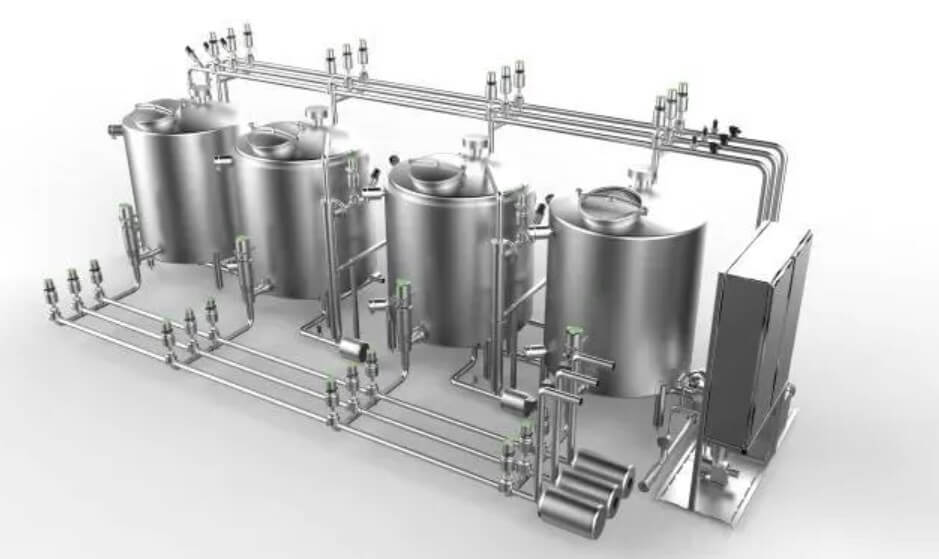
2. Five Engineering Factors That Determine CIP Cleaning Performance
Effective CIP cleaning is commonly explained through the TACT principle: Time, Action, Chemistry, and Temperature. In practical plant design, these factors must be considered together with equipment geometry, drainage, and cleaning solution distribution.
2.1 Cleaning Time
Cleaning time refers to the period during which the cleaning solution remains in contact with the surfaces being cleaned under the required operating conditions.
The required time depends on several factors:
- Type and quantity of product residues
- Degree of fouling and deposit formation
- Cleaning chemical formulation and concentration
- Cleaning solution temperature
- Flow conditions and mechanical action
- Equipment design and surface accessibility
For example, milk processing equipment may accumulate fat and protein residues, while juice processing equipment may develop deposits containing sugars, pulp, pectin, and other organic materials.
Increasing the cleaning time may improve cleaning performance when other parameters are properly controlled. However, longer cleaning cycles do not necessarily produce better results if the chemical concentration, temperature, or mechanical action is insufficient.
The optimal cleaning time should therefore be established through cleaning trials and verification rather than applying one fixed circulation time to every processing line.
2.2 Cleaning Temperature
Temperature affects the chemical reactions, solubility, and removal of different types of deposits.
In general:
- Higher temperatures can improve the removal of certain fats and protein residues.
- Temperature influences the reaction rate of alkaline and acidic cleaning solutions.
- Excessive temperatures may cause protein deposits to become more difficult to remove.
- Some cleaning chemicals and equipment materials have specific operating temperature limitations.
For example, alkaline cleaning solutions are commonly used to remove organic deposits from dairy and food processing equipment. However, the appropriate temperature depends on the soil characteristics, detergent formulation, and equipment being cleaned.
The cleaning temperature should be controlled throughout the circulation circuit, not only at the CIP storage tank. Heat losses in long pipelines and large processing systems can cause the temperature at the return point to differ from the supply temperature.
A properly designed CIP system uses temperature sensors and a heating system, such as a steam-heated or electrically heated heat exchanger, to maintain the required cleaning temperature.
2.3 Cleaning Chemical Concentration
Cleaning chemicals are selected according to the type of contamination and the materials of construction of the processing equipment.
The two main categories of chemical cleaning solutions used in food processing CIP systems are alkaline detergents and acidic detergents.
Alkaline cleaning
Alkaline detergents, commonly formulated with sodium hydroxide (NaOH), are primarily used to remove organic deposits such as:
- Fats and oils
- Proteins
- Food residues
- Certain carbohydrate-based deposits
The effectiveness of alkaline cleaning depends on the detergent formulation, concentration, temperature, and circulation conditions.
Acid cleaning
Acidic detergents, which may contain nitric acid, phosphoric acid, or other suitable acidic components, are used mainly to remove mineral deposits and inorganic scale.
Acid cleaning is particularly relevant in dairy processing, where mineral deposits can accumulate on heat-transfer surfaces and other equipment.
Acid cleaning is not necessarily required after every production batch. Its frequency should be determined by the type of product, water quality, deposit formation, and the validated cleaning program.
Chemical concentration control
The concentration of the cleaning solution must remain within the specified operating range throughout the cleaning cycle.
Conductivity measurement is commonly used in automated CIP systems to monitor the concentration of alkaline and acidic solutions. However, conductivity is affected by temperature and the specific chemical formulation. Therefore, the conductivity-to-concentration relationship should be calibrated for the actual cleaning chemicals being used.
Excessive chemical concentration does not always improve cleaning performance. It can increase operating costs, cause material compatibility problems, and make rinsing more difficult.
The correct concentration should be established based on the detergent supplier’s recommendations and validated cleaning requirements.
2.4 Cleaning Flow Velocity and Mechanical Action
Flow velocity is one of the most important engineering parameters in CIP pipeline cleaning.
When cleaning solution circulates through pipelines, it generates mechanical action that helps detach and transport product residues from the internal surfaces.
For conventional pipework, a flow velocity of approximately 1.5 m/s is often used as an initial engineering reference. However, this is not a universal requirement for every CIP application.
The actual required flow rate depends on:
- Pipe diameter and length
- Pipeline configuration and elevation changes
- Number of branches and connected equipment
- Product residue characteristics
- Pump performance and system pressure losses
- Equipment manufacturer’s cleaning requirements
The relationship between flow velocity and flow rate can be calculated using:
Q = v × A
Where:
- Q = volumetric flow rate (m³/s)
- v = average fluid velocity (m/s)
- A = internal cross-sectional area of the pipe (m²)
For a circular pipe:
A = π × D² / 4
Where D is the internal pipe diameter.
This relationship is important when selecting CIP circulation pumps and determining the required cleaning flow rate for different pipeline circuits.
Flow regime and turbulence
The Reynolds number (Re) is commonly used to characterize fluid flow in pipelines:
Re = ρ × v × D / μ
Where:
- ρ = fluid density (kg/m³)
- v = average flow velocity (m/s)
- D = pipe internal diameter (m)
- μ = dynamic viscosity (Pa·s)
Turbulent flow can improve mixing and mechanical action during pipeline cleaning. However, achieving turbulent flow alone does not guarantee effective CIP cleaning. The cleaning solution must also reach all product-contact surfaces, and the chemical, temperature, and time parameters must be appropriate.
It is also important to distinguish pipeline cleaning from tank cleaning. In pipelines, cleaning performance is strongly influenced by flow velocity and the resulting flow conditions. In tanks, spray devices such as spray balls or rotary spray heads are used to distribute cleaning solutions over internal surfaces. Their coverage, spray characteristics, installation position, and required flow and pressure must be considered during system design.
2.5 Equipment Design, Drainability, and Cleaning Coverage
Even when the correct cleaning temperature, chemical concentration, circulation time, and flow rate are achieved, poor equipment design can still result in incomplete cleaning.
A hygienic CIP-compatible design should consider the following aspects:
Smooth product-contact surfaces
Product-contact surfaces should be designed and finished appropriately to minimize residue accumulation and facilitate cleaning. The required surface finish depends on the application and applicable hygienic design standards.
Avoiding dead legs
Dead legs are sections of pipework or equipment where product or cleaning solution may remain stagnant or where circulation is insufficient.
Poorly designed branches, unused connections, instrument fittings, and valve arrangements can create areas that are difficult to clean.
Proper drainage
Pipelines and equipment should be designed to allow cleaning solutions and rinse water to drain effectively.
Undrained liquid can dilute the next cleaning solution, leave chemical residues, and create conditions that compromise hygiene.
Correct spray device selection
For tanks and vessels, spray balls or rotary spray devices must be selected according to tank dimensions, internal geometry, surface requirements, and available flow and pressure.
A spray device should not be selected solely based on its nominal size. Its actual cleaning coverage and performance must be verified under the intended operating conditions.
Correct valve and pipeline configuration
CIP supply and return pipelines, valves, and connections should be arranged to ensure that cleaning solutions reach all designated product-contact surfaces.
The system should also prevent unintended mixing between product, cleaning chemicals, and rinse water.
These design considerations are particularly important for complex processing plants containing multiple tanks, heat exchangers, pasteurizers, sterilizers, and filling systems.
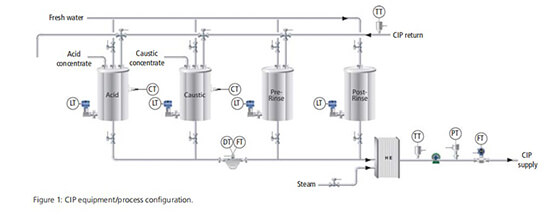
3. TACT Principles and Automated CIP Process Control
The TACT principle represents four major factors affecting cleaning performance:
- Time: How long the cleaning solution remains in contact with the surfaces.
- Action: The mechanical effect generated by fluid circulation or spray devices.
- Chemistry: The cleaning chemical formulation and concentration.
- Temperature: The operating temperature of the cleaning solution.
These four factors are interrelated. If one parameter changes, the others may need to be adjusted to maintain the required cleaning performance.
For example, a lower cleaning temperature may require a different detergent formulation or longer cleaning time. Similarly, inadequate flow conditions cannot necessarily be compensated for simply by increasing chemical concentration.
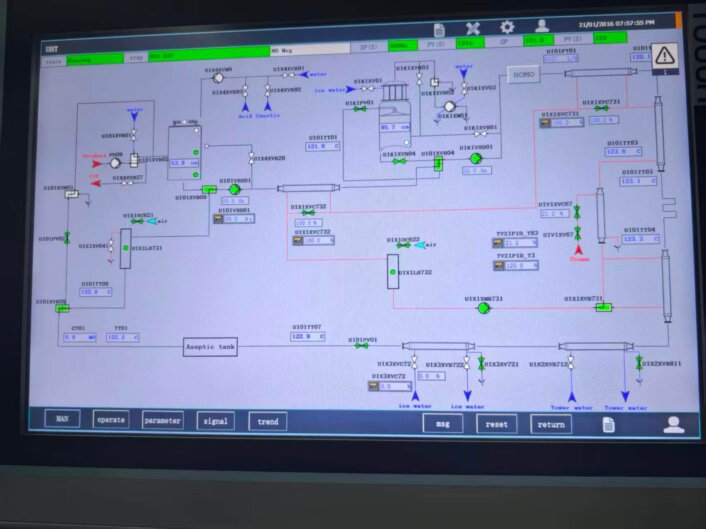
In an automated CIP system, these parameters can be monitored and controlled through a PLC-based control system.
Typical automation functions include:
- Automatic switching of CIP supply and return valves
- Cleaning solution circulation pump control
- Cleaning temperature monitoring and control
- Chemical dosing and concentration monitoring
- Tank liquid level monitoring
- Flow rate and pressure monitoring
- Automatic switching between cleaning stages
- Cleaning cycle timing and sequence management
- Alarm management and process data recording
For industrial food processing plants, a fully automated CIP system can also record important cleaning parameters for each cleaning cycle.
Depending on the PLC, HMI, instrumentation, and data management configuration, records may include cleaning start and end times, temperature trends, flow rate, pressure, conductivity, alarm events, and cleaning stage information.
These records help production and quality teams review whether the programmed cleaning conditions were achieved.
However, recording process parameters is not the same as proving that the equipment is clean. Cleaning verification and validation are still required.
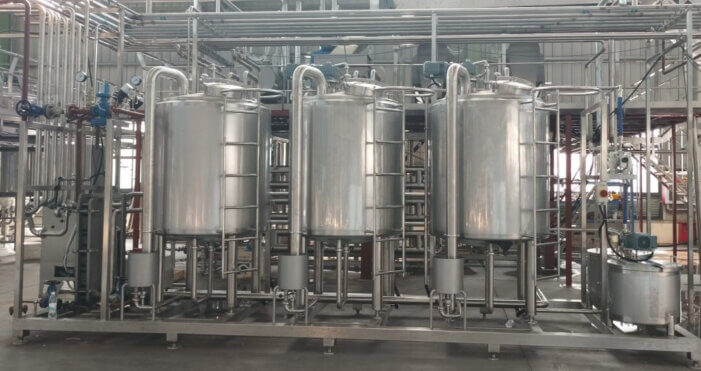
4. CIP Cleaning Validation and Verification
CIP cleaning validation is the process of demonstrating that a defined cleaning procedure can consistently remove the relevant product residues and contaminants to an acceptable level.
The validation approach should be based on the product, equipment, contamination risks, and intended production requirements.
Common verification methods include:
Visual inspection
Visual inspection can identify visible residues, deposits, and remaining contamination in accessible areas. However, it cannot confirm the absence of microorganisms or invisible chemical residues.
Rinse water testing
The final rinse water can be checked for relevant parameters such as conductivity, pH, or specific chemical residues. These tests help determine whether cleaning chemicals have been adequately removed.
ATP testing
ATP testing is a rapid method for detecting residual biological material on surfaces. It is useful for routine hygiene monitoring, but it does not directly measure specific microorganisms and should not be treated as a substitute for microbiological testing.
Microbiological testing
Microbiological sampling can be used to assess microbial contamination on selected equipment surfaces or in rinse water, according to the established sampling plan and acceptance criteria.
Riboflavin coverage testing
Riboflavin testing is sometimes used to evaluate spray coverage inside tanks and vessels. It helps identify areas that may not receive sufficient spray contact.
However, a successful riboflavin test does not independently prove that product residues have been removed or that microbiological requirements have been met.
A reliable CIP validation program should combine appropriate cleaning parameter monitoring with suitable verification methods and documented acceptance criteria.
5. Frequently Asked Questions About the CIP Cleaning Process
5.1 What is the difference between CIP and SIP?
CIP stands for Clean-in-Place. It is a cleaning process designed to remove product residues and contaminants from equipment without dismantling the system.
SIP stands for Sterilization-in-Place. It is a sterilization process, commonly using steam or another validated sterilization method, to achieve the required level of microbial inactivation in compatible equipment.
CIP and SIP have different purposes. Cleaning must generally be completed before sterilization.
5.2 How often should a CIP system be used?
The cleaning frequency depends on the product, production schedule, equipment design, contamination risks, and hygiene requirements.
In many food and beverage plants, CIP cleaning is performed after each production run or product change. Some systems may also require intermediate cleaning during production.
The cleaning frequency should be established through the plant’s hygiene management program.
5.3 Can CIP cleaning solutions be reused?
Yes. Many industrial CIP systems are designed to recover and reuse alkaline and acidic cleaning solutions.
Before reuse, the recovered solution should be assessed according to its concentration, contamination level, temperature, and suitability for the next cleaning cycle.
A properly designed recovery system can reduce water, chemical, and energy consumption.
5.4 Does a higher cleaning flow rate always produce better results?
No. Increasing the flow rate can improve mechanical cleaning action in pipelines, but the required flow rate depends on pipe diameter, system pressure losses, pump capacity, and equipment design.
Excessive flow may increase energy consumption, pressure losses, and mechanical stress without providing a meaningful improvement in cleaning performance.
The flow rate should be determined through engineering calculations and verified under actual operating conditions.
5.5 Is a fully automatic CIP system necessary for every food and beverage processing plant?
Not necessarily. Small production facilities or individual machines may use manual or semi-automatic CIP systems.
However, medium- and large-scale processing plants with multiple production circuits, tanks, heat exchangers, and sterilization equipment can benefit significantly from fully automatic CIP systems.
The appropriate automation level depends on production capacity, cleaning frequency, labor requirements, process complexity, and traceability needs.
Conclusion
The effectiveness of a CIP cleaning process depends on more than simply circulating hot water and cleaning chemicals through a processing line.
Cleaning time, chemical concentration, temperature, flow velocity, equipment design, and cleaning solution distribution must work together to achieve reliable cleaning performance.
For food and beverage manufacturers, a properly engineered CIP system should be designed around the actual production process, product characteristics, equipment configuration, and required hygiene standards.
We provide customized CIP cleaning systems for juice, beverage, dairy, and liquid food processing plants. System configurations can be designed according to production capacity, cleaning circuits, tank requirements, heating methods, and automation needs.
Looking for a CIP cleaning solution for your processing plant?
Contact IBC Machinery to discuss your production requirements and CIP system design.