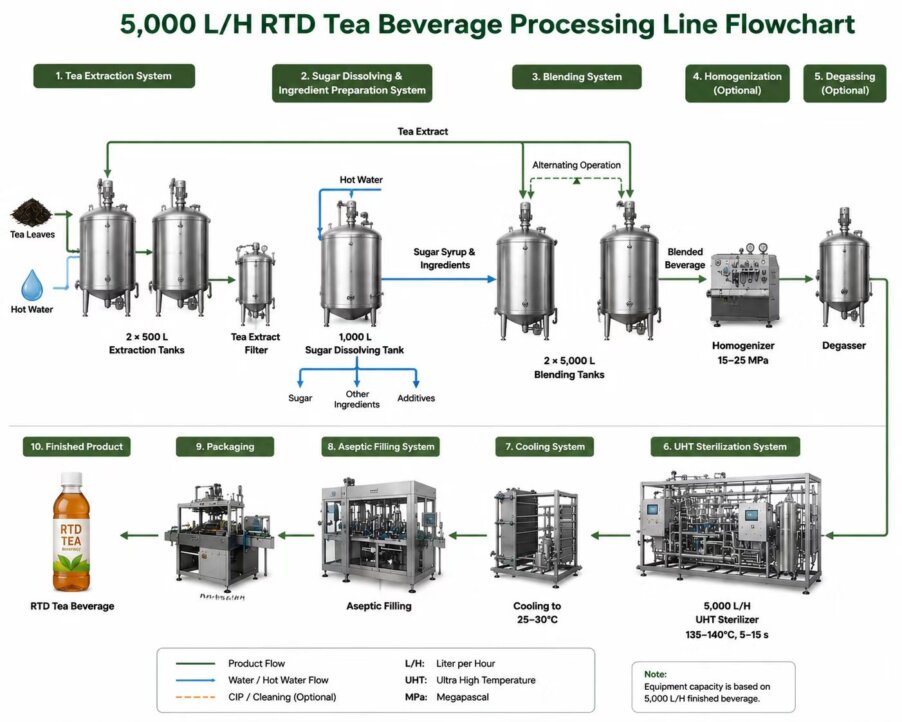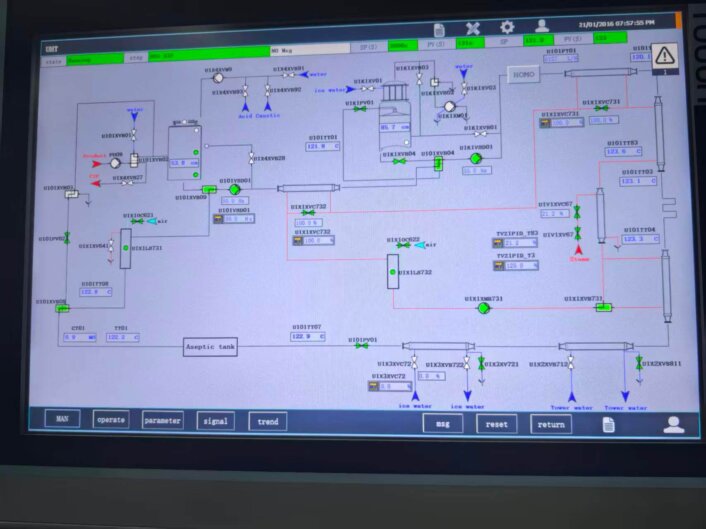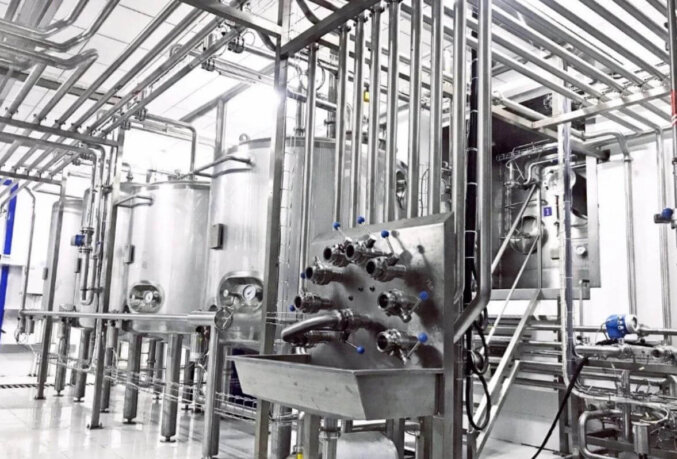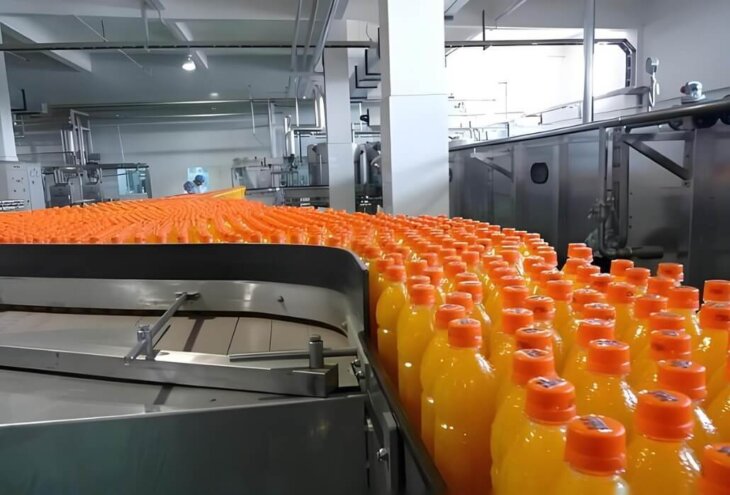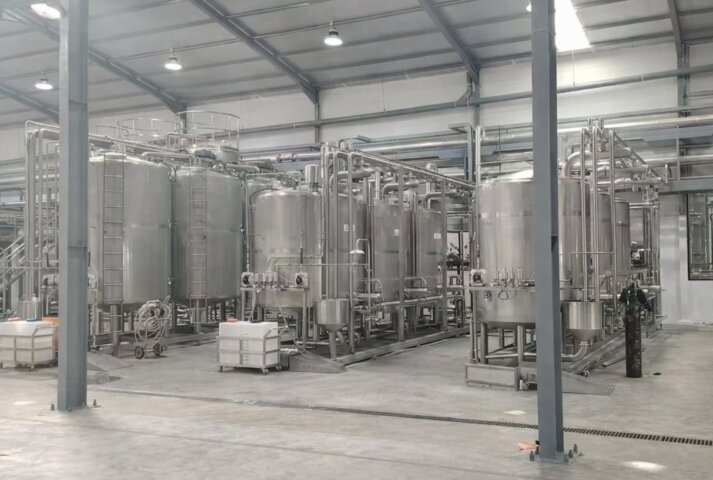
In a complete liquid food and beverage production plant, whether it is the production of juice, puree, jam, etc., or the production of milk and plant-based beverage products, water, electricity, steam and compressed air are indispensable. Because the liquid food and beverage production plant are essential to process the material into a stable shelf life, edible or drinkable products by physical (cleaning, crushing, heating, cooling, evaporation, drying) or chemical methods (material mixing, ingredient addition, packaging container cleaning).
In this series of processing processes, water is required for cleaning materials or packaging containers, steam is required for heating materials, tower water or ice water is required for cooling materials, and RO pure water is required for materials mixing, preparing, sterilizing, etc. The machine running will be driven by the power (motor) or compressed air. Therefore, boiler (producing steam), cooling tower (producing cooling water), ice/chill water unit (producing ice water), RO reverse osmosis system (producing RO pure water), air compressor (producing compressed air), generator (supplying electricity ) and so on are all public energy equipment that is necessary for the operation of the production line. Below we will give a brief introduction to the equipment that produces these public energy sources.
Steam Boiler
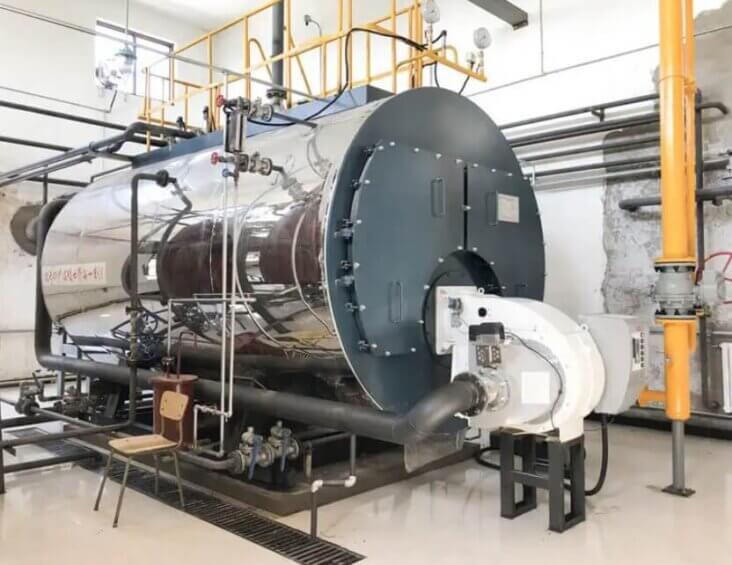
Steam Boiler Application
The boiler is an important piece of equipment for providing steam or superheated water in food and beverage plants. Material preheating, bleaching, enzyme inactivation, thermal dissolving of sugar powder ingredients, material preparation and blending, pasteurization/sterilization, milk, fruit juice or jam concentration, material drying, the heating of CIP cleaning liquid and other places that require a heat source need to use the steam or superheated water generated by the boiler.
Steam Boiler composition
The fuels used in industrial boilers are mainly coal, natural gas, fuel oil, biomass and electricity. At present, because the global is committed to reducing carbon emissions and reducing dependence on fossil fuels, new energy boilers such as natural gas and biomass are more and more popular in the market. A complete boiler system typically includes:
-
Boiler unit
-
Feed water treatment system (softener / RO)
-
Feed water tank and deaerator
-
Steam distribution piping
-
Condensate recovery system
-
Control and safety devices
Steam Boiler Feature
- The boiler water needs to be softened, so before purchasing, it is necessary to propose to the boiler supplier that the boiler system needs to be equipped with water softener equipment.
- In addition, the steam of the boiler will be partially lost during the transmission process due to the influence of the transmission distance and steam pressure. Therefore, in the process of boiler configuration, the required capacity needs to be larger than the actual production capacity.
- Since there is more than one point of use of steam in the production line, it is necessary to equip the steam distribution cylinders when steam or superheated water is transmitted.
- Since the boiler is also a type of pressure vessel, the boiler supplier needs to issue a pressure vessel manufacturing and installation certificate, usually with ASME, CE, or local boiler codes.
- In the process of industrial use, as the consumption of steam or hot water is large, the choice of fuel is also very important. It is best to choose fuel with low-cost and high-cost performance.
- The steam pipeline uses using seamless steel pipeline with rock wool insulation and a covered stainless steel skin.
- The steam boiler pressure is less than 6 bar in liquid food and beverage processing plant.
Cooling Tower
Cooling Tower Description
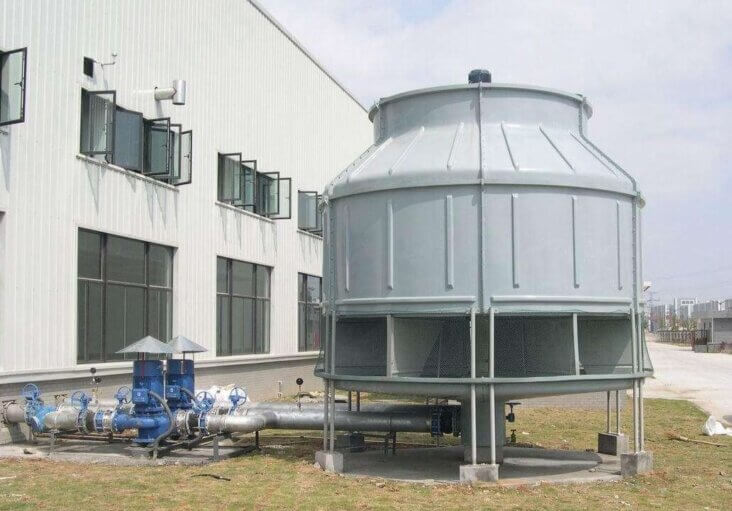
The cooling tower is a key utility system is used to remove excess heat from production processes and maintain stable operating temperatures. Cooling towers dissipate heat from circulating cooling water through evaporation, enabling efficient and continuous operation of thermal equipment across the plant.
It is a device that uses water as a circulating coolant to absorb heat from a system and discharge it into the atmosphere to reduce the temperature of the water. In beverage production lines, most of the evaporators, sterilizers, spray-type or water bath pasteurization systems, and retort sterilizer requires cooling water to cool down materials. Cooling towers are divided into circular cooling towers or square countercurrent cooling towers.
Cooling Tower Application
-
Cooling of pasteurizers and UHT systems
-
Heat removal from evaporators and condensers
-
Support for chillers and refrigeration systems
-
Cooling of air compressors and auxiliary equipment
-
Recovery and reuse of cooling water for energy efficiency
Cooling Tower Feature
- Usually, the cooling tower water can cool down the material to 40-50℃ based on the local ambient temperature.
- The cooling tower water pipelines use hot-dip galvanized steel pipelines to transfer cooling water to the equipment.
- The cooling tower water is circulated when cooling the materials.
- Cooling tower capacity can be calculated based on what machines need to use the water and how much cooling water is needed for each heat exchanger machine. Most of the machines needed for cooling water are sterilizers, plate/tubular coolers and evaporators.
Cooling Tower Technical Parameter
| Parameter | Typical Value |
|---|---|
| Cooling water inlet temp. | 35–40 °C |
| Cooling water outlet temp. | 28–32 °C |
| Temperature difference | 5–8 °C |
| Ambient wet bulb temp. | Site-dependent |
Water Chiller Unit
Water Chiller System Description
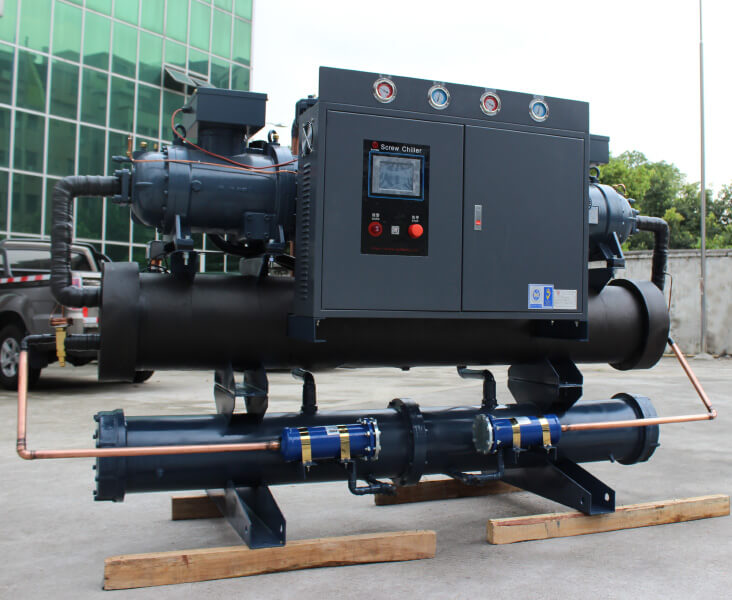
In the refrigeration industry, there are two types of air-cooled chillers and water-cooled chillers. According to the compressor, they are divided into screw chillers, scroll chillers and centrifugal chillers.
In terms of temperature control, it is divided into low-temperature industrial chillers and normal-temperature chillers. The temperature of normal temperature units is generally controlled within the range of 0 degrees to -35 degrees. The temperature control of the low-temperature unit is generally about 0 degrees to -100 degrees. In the beverage production line, especially the production of milk, carbonated beverages, vegetable protein beverages, NFC juice, egg liquid and other materials, chillers are required to cool the materials by 4-10℃.
Water Chiller System Application
Chilled water systems support multiple production and utility operations, including:
-
Rapid product cooling after pasteurization or UHT processing
-
Fermentation temperature control in yogurt, beverage, and brewing applications
-
Aseptic process cooling to maintain sterile conditions
-
Cooling of fillers, mixers, and process equipment
-
Support cooling for CIP heat recovery systems
Water Chiller System Feature
- Generally speaking, air-cooled chillers are used for materials with small production capacities, and water-cooled chillers are used for production lines with large and medium production capacities. One chill water unit is composed of the chiller, water tanks and cooling tower.
- Ice water pipes are hot-dip galvanized steel pipelines insulated with rubber pipes.
- The outlet water temperatures of ice water units are 7℃, 2℃ or -5℃ for common use in liquid food and beverage processing plants.
- The most common machines that need ice/chill water to cool down the materials are sterilizers, heat exchangers, and all kinds of jacketed tanks.
Air Compressor
In liquid food and beverage processing plants, an air compressor system is a critical utility that provides stable, clean, and controlled compressed air for automation, process control, and packaging operations. Compressed air is often regarded as the “fourth utility” in food processing, alongside water, electricity, and steam.
An air compressor is a device used to compress air, the compressed air can act as a drive source to drive the cylinder to operate. It is widely used in pneumatic valves, pneumatic pumps, pneumatic filling machines and bottle blowers in liquid food and beverage processing plant.
Role of Compressed Air in Food & Beverage Plants
In liquid food and beverage processing plants, an air compressor system is a critical utility that provides stable, clean, and controlled compressed air for automation, process control, and packaging operations. Compressed air is often regarded as the “fourth utility” in food processing, alongside water, electricity, and steam.
An air compressor is a device used to compress air, the compressed air can act as a drive source to drive the cylinder to operate. It is widely used in pneumatic valves, pneumatic pumps, pneumatic filling machines and bottle blowers in liquid food and beverage processing plant.
Compressed air supports a wide range of production and auxiliary functions, including:
-
Pneumatic valve and actuator operation
-
Control of pasteurizers, UHT systems, and CIP valves
-
Aseptic air supply for tanks and filling machines
-
Packaging equipment operation (filling, capping, labeling)
-
Instrument air for PLC and control systems
Air Compressor Composition
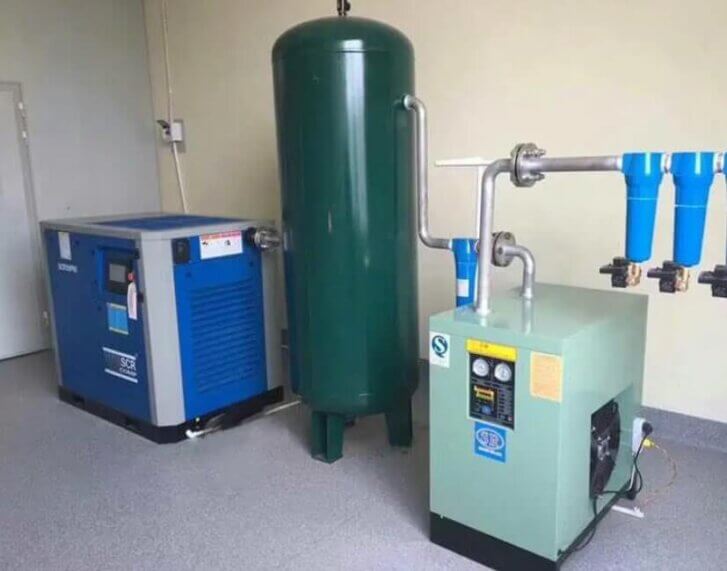
It is divided into low-pressure air compressors and high-pressure air compressors, it mainly includes air freeze dryer, C/T/A three-stage filtration, carbon steel gas storage tank, internal pipe valves and other auxiliary accessories. The compressed air pipelines are stainless steel thick-walled pipes.
Air Compressor Technical Parameter
| Parameter | Typical Requirements |
|---|---|
| Oil content | Class 0 / ≤0.01 mg/m³ |
| Particle size | ≤0.01 μm |
| Pressure dew point | ≤-40 °C |
| Microbial control | Sterile air filtration |
| Working pressure | 0.6–0.8 MPa |
| Air temperature (after drying) | Ambient |
Power Generator
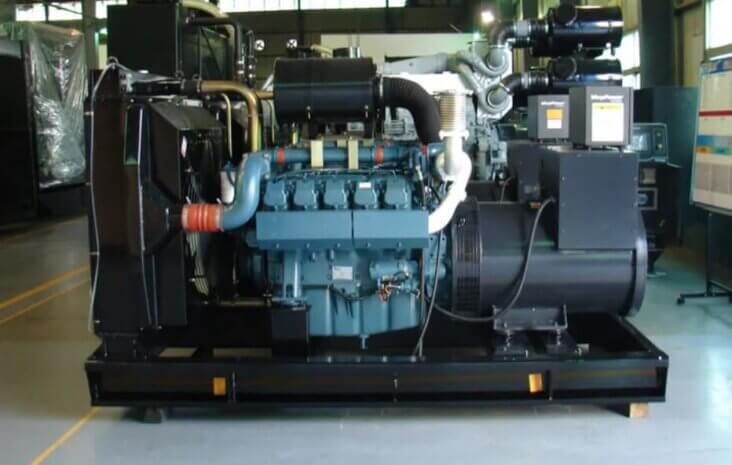
Generators are mechanical devices that convert other forms of energy into electrical energy, in the industrial field, the power generators are usually using diesel, and gasoline as energy sources to generate power. All the motors in machines are driven by power, so it is also very important public energy equipment in liquid food and beverage processing plant, but most of the plant has their own power source distribution in the city, so there is no need for equipping one extra power generator.
RO water Generating Unit
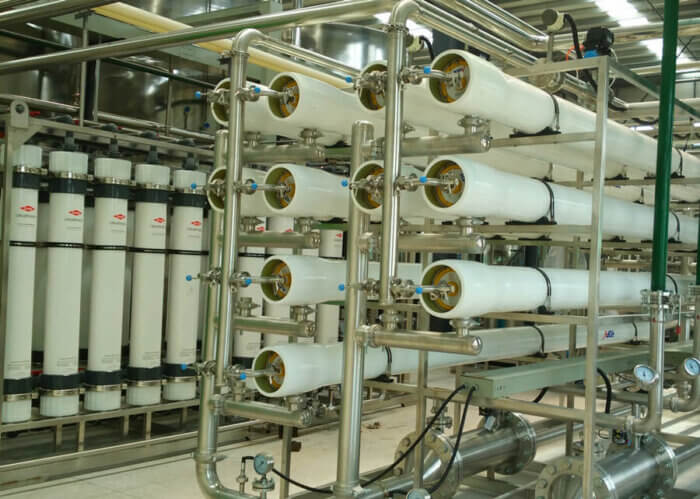
RO water system is a device to generate pure water from tap water, mountain water, river water or lake water. In beverage processing plants, water is the most important ingredient, whether you produce drinking water, juice, carbonated drinks or other type of drinks, RO pure water quality is the key factor of the end products quality. This system mainly uses the reverse osmosis membrane to filter and remove impurities from raw water to get pure water.
The most common equipment that needs RO water is blending tanks, extraction tanks, grain grinding machines, hot water generating systems, material dissolving systems, CIP system and bottle washing machines.