Project Overview
This tomato paste dilution line project in Saudi Arabia was designed to process high-concentration tomato paste supplied in 220 kg drums and convert it into a ready-to-pack tomato paste product with a target soluble solids content of 20–24°Brix.
The line has a nominal processing capacity of 2 T/H of diluted tomato paste. It integrates concentrate handling, water treatment, dilution and blending, salt addition, homogenization, vacuum deaeration, four-layer tube-in-tube sterilization, aseptic storage, aseptic product distribution, and aseptic carton filling.
The final formulation contains 1% food-grade salt by total formulation weight. Considering the product formulation and corrosion-resistance requirements, all equipment product-contact parts throughout the processing line are made of SUS316L stainless steel.
A 5,000 L aseptic tank with mechanical agitation is installed between the sterilizer and the filling machines. Mechanical agitation was selected instead of magnetic agitation to better accommodate the relatively high viscosity of the tomato paste product. To distribute the sterilized product to the two filling machines, the project also includes two GEA-brand aseptic cross-valve manifolds and three L-type aseptic valves.
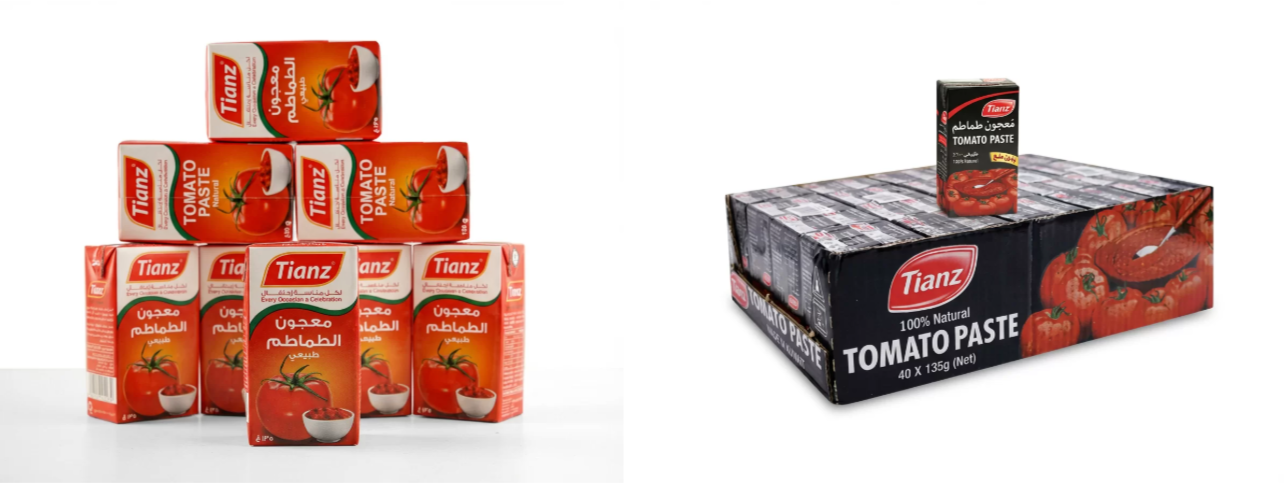
The final product is packed in 135 g aseptic brick cartons using two Chinese-manufactured aseptic carton filling machines, each with a rated capacity of 7,500 packs per hour.
This project demonstrates an engineering approach for food manufacturers that want to process imported tomato paste concentrate locally, adjust the product concentration to meet market requirements, and package it in convenient retail formats.

Tomato Paste Dilution Line Specification
Tomato Paste Dilution Process Flow and Equipment List
The processing sequence is designed to ensure consistent dilution, uniform salt distribution, effective air removal, validated thermal processing, and hygienic transfer to the aseptic filling section.
Process flow and Equipment List :
→ Drum unloading and concentrate transfer with 2000kg/H
→ RO-treated water preparation and metering with 2000L/H
→ Dilution, salt addition, and blending in 2 × 2,000 L tanks
→ Homogenization with 2000L/H
→ Vacuum deaeration with 2000L/H
→ Tube-in-tube sterilization with 2000L/H
→ 5,000 L mechanically agitated aseptic tank
→ Two aseptic carton filling machines 7500 packs/h with 135g aseptic cartons
Tomato Paste Dilution Line Main Equipment Introduction
Tomato Paste Drum Unloading and Transfer
The 36–38°Brix concentrated tomato paste is supplied in 220 kg drums. A NETZSCH NEMO® inverted screw drum emptying pump, with a rated capacity of 2,000 kg/h, will transfer the paste directly from the drums to the blending tanks.
Equipped with a follower plate, the single-screw pumping system provides smooth, low-pulsation transfer of the high-viscosity paste while minimizing drum residue and product loss. All product-contact components will comply with the project’s SUS316L stainless steel specification for hygienic handling and corrosion resistance.
RO Water Treatment and Dilution System
The project includes a water treatment system rated at 2 T/H. Treated water is metered and mixed with the tomato paste concentrate to achieve the required final Brix level.
The water addition ratio can be accurately controlled using either an inline flow meter to measure the water flow rate or METTLER TOLEDO load cells installed under the blending tank support legs to measure the tank weight during filling. These options enable precise water dosing according to the tomato paste concentrate concentration and target final Brix level.
For salt addition, a 100 L salt dissolving tank is provided to dissolve food-grade salt in water before pumping the salt solution into the blending tanks. Salt is added according to the approved formulation, at 1% of the total final formulation weight. The salt solution preparation, dosing, and mixing conditions will be established during process design and verified through production trials.
For an ideal mass balance, assuming negligible solids loss and initially excluding the salt addition:
- To dilute 36°Brix concentrate to 22°Brix, the concentrate represents approximately 61.1% of the concentrate-and-water mixture by mass.
- To dilute 38°Brix concentrate to 22°Brix, the concentrate represents approximately 57.9% of the concentrate-and-water mixture by mass.
These are theoretical calculations based on soluble-solids concentration before accounting for the salt addition. Actual production settings should be confirmed through formulation calculations, Brix measurements, and product trials.
Two 2,000 L Blending Tanks
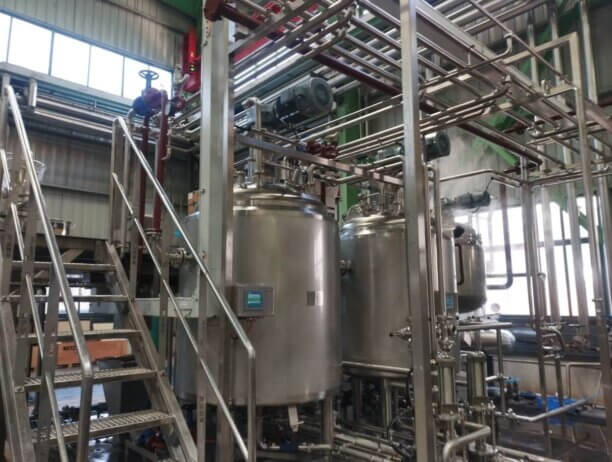
The tomato paste dilution line is equipped with two 2,000 L blending tanks for mixing concentrated tomato paste, treated water, and food-grade salt. Each tank is constructed from SUS316L stainless steel with a three-layer structure, a coil-jacketed design, a sealed manway, a CIP cleaning ball, and dished heads.
Each tank features a top-mounted coaxial dual-agitator system with an intermediate-frame agitator and a paddle agitator, operating at a specified speed of 36 RPM, together with anti-vortex baffles to promote effective mixing. Additional fittings include a breather valve, digital temperature indicator, sampling valve, identification plate, and four adjustable support legs.
Vacuum Degasser, Homogenizer and Tube-in-Tube Sterilizer with 2000KG/H
After blending, the tomato sauce passes through a duplex filter and is preheated to 60–70°C in the four-layer tube-in-tube heat exchanger. It then enters the vacuum deaerator, followed by the homogenizer, before returning to the tube-in-tube sterilizer for final heat treatment.
Vacuum Deaerator: After preheating to 60–70°C in the four-layer tube-in-tube sterilizer, the tomato sauce passes through a vacuum deaerator to remove entrained air, helping reduce oxidation and foam formation. All product-contact parts are made of SUS316L stainless steel,
Homogenizer: All product-contact parts are SUS316L stainless steel. The maximum pressure rating is 40 MPa, with an operating range of 0–32 MPa. It features manual pressure adjustment, VFD starting, and an independent control cabinet.
Four-Layer Tube-in-Tube Sterilizer: The product is heated to 108°C, held for 30–120 seconds, and then cooled to approximately 25°C before entering the aseptic storage and filling section. All product-contact surfaces are specified in SUS316L stainless steel. The heating and cooling stages are designed according to the product’s viscosity, flow characteristics, and heat-transfer requirements.
Aseptic Tank with 5000L
After sterilization, the tomato paste is transferred to a 5,000 L aseptic tank before filling. The tank provides a sterile buffer between the continuous sterilizer and the carton filling machines, accommodating short-term variations in processing and filling rates.
Mechanical agitation is selected instead of magnetic agitation because of the product’s relatively high viscosity. The agitator design and operating parameters are suited to the product’s rheological properties while maintaining uniformity and aseptic conditions.
All product-contact surfaces are made of SUS316L stainless steel. The tank, agitator shaft seal, downstream piping, and valves are designed to maintain aseptic integrity throughout storage and transfer.
GEA Aseptic Valve Manifolds and L-Type Aseptic Valves
After leaving the 5,000 L aseptic tank, the sterilized tomato sauce is distributed to two aseptic carton filling machines through two GEA-brand aseptic cross-valve manifolds and three L-type aseptic valves.
The valve arrangement enables controlled product routing while maintaining aseptic integrity. All product-contact components comply with the project’s SUS316L stainless steel specification. Valve sequencing, cleaning and sterilization procedures, and control interlocks will be coordinated according to the final P&ID to prevent cross-contamination and maintain aseptic conditions.
Two Aseptic Brick Carton Filling Machines
The project uses two Chinese-manufactured aseptic brick carton filling machines. Each machine has a rated capacity of 7,500 packs per hour, giving a combined nominal filling capacity of 15,000 packs per hour.
The package size is 135 g, corresponding to a theoretical combined product demand of: 15,000 packs/h × 135 g/pack = 2,025 kg/h. This is approximately 2.025 T/H, slightly higher than the nominal processing capacity of 2 T/H.
Key Engineering Considerations for Tomato Paste Dilution Line
Match Concentrate and Water Feeding Rates
The concentrate-to-water ratio changes according to the incoming Brix level and the target product concentration.
Automatic or carefully controlled metering, together with regular Brix checks, can help maintain product consistency. Salt dosing should also be controlled according to the approved final formulation, with food-grade salt accounting for 1% of the total formulation weight. The actual feeding settings should be established during commissioning.
Verify Blending Capacity Against Continuous Output
The two 2,000 L blending tanks must provide sufficient usable volume and batch turnover to sustain the downstream 2 T/H processing rate.
The assessment should consider actual product density, mixing time, transfer time, salt dissolution and distribution, tank filling and emptying cycles, and any planned production interruptions.
Coordinate Aseptic Storage and Filling
The 5,000 L aseptic tank provides an intermediate buffer, but its effective buffering performance depends on the actual flow rate and operating conditions.
Because the tank uses mechanical agitation, the agitator, shaft seal, and tank must be designed to preserve aseptic conditions while handling the viscous product. The valve manifolds and downstream piping must also support reliable product distribution to both filling machines.
The sterilizer, aseptic tank, valve manifolds, transfer piping, and filling machines should be assessed as one integrated aseptic system. Start-up, shutdown, cleaning, sterilization, and recovery procedures must be incorporated into the operating design.
Specify SUS316L for All Product-Contact Parts
The final tomato paste formulation contains 1% food-grade salt by total formulation weight. In consideration of the formulation, food hygiene requirements, and corrosion resistance, all equipment product-contact parts throughout this project are specified in SUS316L stainless steel.
This requirement covers product-contact surfaces in the blending, homogenization, deaeration, sterilization, aseptic storage, aseptic valve manifolds, aseptic valves, and product transfer sections, together with other product-contact components included in the equipment supply scope.
Why Is Diluted Tomato Paste in Aseptic Brick Cartons Popular in Middle Eastern Markets?
Tomato paste is an important ingredient in many Middle Eastern home-cooked dishes. It is commonly used to prepare stews, soups, rice dishes, and meat-based meals, adding rich tomato flavor, color, and consistency. For many households, tomato paste is a regular kitchen staple rather than an occasional condiment.
Aseptically packed tomato paste in Tetra Pak-style cartons offers a convenient retail format for everyday cooking. By importing concentrated tomato paste at 36–38°Brix and diluting it locally to a target of 22–24°Brix, manufacturers can produce a ready-to-use tomato product suited to local consumer preferences and packaging requirements. The cartons are easy to store, handle, and distribute through retail channels, making the product practical for household use.
This market model combines the logistical advantages of transporting concentrated tomato paste with the convenience of a ready-to-use product for consumers. The final Brix level and formulation should be tailored to the target market and the customer’s product specifications.