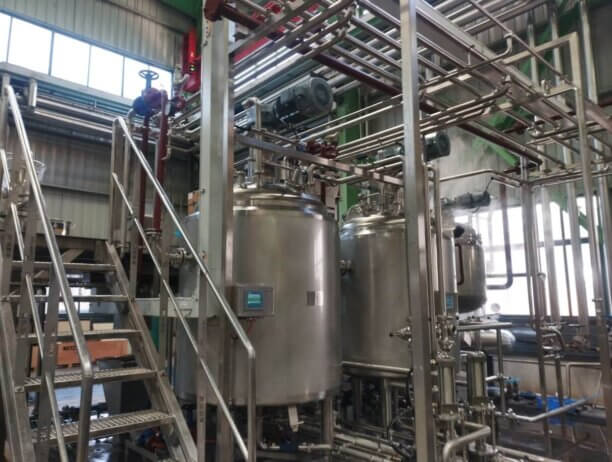
Greek Yogurt Production Project Overview
This Australian dairy processing project is designed for the production of Greek yogurt, non-concentrated high-protein sweetened yogurt, and non-concentrated high-protein unsweetened yogurt.
The complete Greek yogurt production line integrates raw milk reception, milk storage, ingredient mixing and standardization, pasteurization, cream separation, homogenization, yogurt fermentation, centrifugal yogurt concentration, cooling, smoothening, buffer storage, CIP cleaning, and final yogurt filling.
The designed production capacity is:
- Greek yogurt: 70 tons/day
- Non-concentrated sweetened high-protein yogurt: 30 tons/day
- Non-concentrated unsweetened high-protein yogurt: 60 tons/day
The finished yogurt products are packed in 700 g, 2 kg, and 10 kg tubs, as well as 170 g and 210 g cups.
The viscosity of the different yogurt products ranges from approximately 641 to 3,390 cP at 25°C. The Greek yogurt is designed with a final protein content of approximately 9.5 g/100 g.
The main raw materials include fresh cow’s milk, milk powder, dairy cream, and white sugar.
Greek Yogurt Production Process
The complete production process can be summarized as:
Fresh Milk Reception → Raw Milk Storage → Ingredient Mixing & Standardization → Preheating → Cream Separation → Homogenization → High-Temperature Pasteurization → Cooling to Fermentation Temperature → Yogurt Inoculation & Fermentation → Centrifugal Concentration → Tubular Cooling → Smoothening → Buffer Storage → Filling & Packaging
For non-concentrated sweetened and unsweetened yogurt, the centrifugal concentration stage can be bypassed according to the selected product formulation.
Greek yogurt main process parameters:
| Process | Main Parameter |
|---|---|
| Fresh Raw Milk Receiving | 50 T/H receiving pump with filter, 3 × 35,000 L raw milk storage tanks |
| Milk Standardization&Mixing | 2 × 35,000 L standardization tanks, 20 T/H high-speed mixer for milk powder and sugar dissolution |
| Milk Pasteurization System | 17 T/H, 55–60°C preheating, GEA cream separator, 20 MPa two-stage homogenization, 95°C/10 min holding |
| Yogurt Fermentation System | 12 × 10,000 L tanks, 42–45°C, 7–8 h/batch, automatic pH/temperature/time control. |
| Yogurt Concentration Separator | 2 × 10 T/H GEA KDA30 separators, concentrated yogurt to approx. 9 g/100 g protein. |
| Yogurt Cooling & Smoothening | tubular yogurt coolers, cooling to approx. 15°C, followed by smoothening pumps. |
| Yogurt Buffer & Filling | 3 × 10,000 L buffer tanks, automatic valve matrix, 170 g/210 g cups and 700 g/2 kg/10 kg tubs. |
| CIP System | 2 independent 4-tank, dual-circuit, 4,000 L fully automatic CIP systems. |
Greek Yogurt Production Key Machine and Process Introduction
Raw Milk Reception System
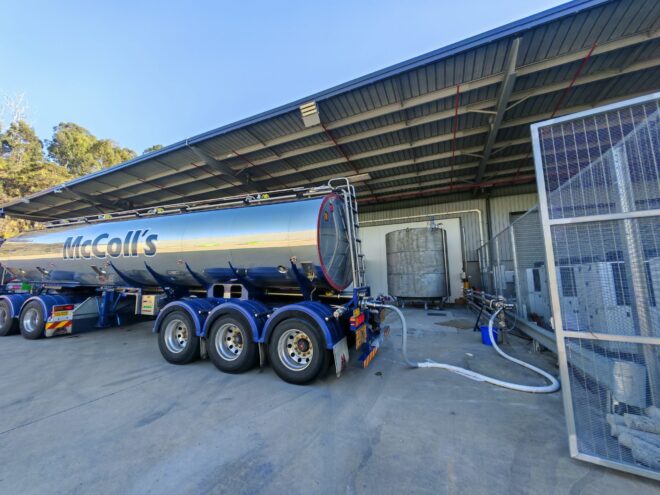
Fresh cow’s milk is transported to the dairy processing plant by milk tankers at approximately 4°C. The milk is transferred from the tanker through a hygienic milk receiving hose and a 50 T/H milk receiving pump. A filtration system is installed in the receiving line to remove foreign particles before the milk enters the storage section. The raw milk is then transferred into three 35,000 L raw milk storage tanks.
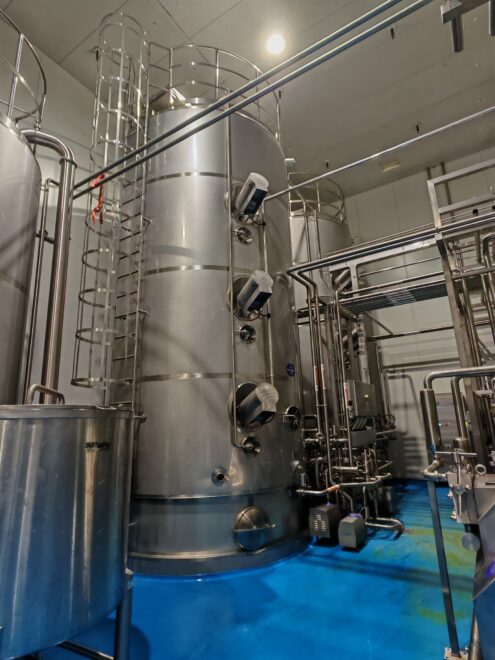
Each milk silo tank is equipped with:
- Three side-mounted agitators
- Agitator speed of approximately 960 rpm
- CIP spray balls
- High, medium, and low-level sensors
- Temperature sensor
- Automatic inlet and outlet valves
The discharge of raw milk from the storage tanks is controlled by the automatic valve matrix system, allowing the control system to automatically select the required tank and product flow path. This reduces manual valve operation and improves production consistency.
Milk Mixing and Standardization System
The milk formulation and standardization section consists mainly of two 35,000 L standardization tanks.
The system is designed to mix:
- Fresh cow’s milk
- Milk powder
- Dairy cream
- White sugar
A 20 T/H high-speed mixing system is installed for the rapid dispersion and dissolution of milk powder and sugar.
The high-speed mixer can operate together with the standardization tanks in a circulation loop. The product is circulated through the mixer until the powder and sugar are completely dissolved and the mixture reaches the required uniformity.
The system also includes an independent cream feeding system; dairy cream is stored in a 1,000 L IBC/tote tank and transferred to the standardization tank through a dedicated cream pump.
The standardization tanks are equipped with:
- Three independent side-mounted agitators
- Level sensors
- Temperature monitoring
- Automatic valves
- CIP spray devices
The high-speed mixer’s shear pump and self-priming pump are supplied by INOXPA, providing reliable operation for powder and sugar mixing applications.
This flexible formulation system allows the plant to adjust the milk base according to the requirements of Greek yogurt, sweetened yogurt, and unsweetened yogurt.
Milk Pasteurization, Cream Separation and Homogenization
After standardization, the milk mixture enters the milk heat treatment system. The project uses a 17 T/H fully automatic four-section plate pasteurization system, specially configured for yogurt production. The system is designed to improve heat recovery and energy efficiency while maintaining stable processing conditions.
The milk first enters the preheating section and is heated to approximately 55–60°C. At this stage, the milk can be sent to a cream separation system using a GEA ECOCREAM disc separator, the cream separation system is designed to reduce the fat content of the skimmed milk to below approximately 0.2%, according to the required standardization process. After separation, the milk passes through a two-stage homogenizer at approximately 20 MPa. Homogenization reduces fat globule size and improves the stability, body, and texture of the yogurt base. The homogenized milk then enters the heating section of the pasteurizer, and the yogurt base is heated to approximately 95°C for 10 minutes. This high-temperature treatment is an important step in yogurt production because it provides effective heat treatment and also supports the development of the desired yogurt structure. After the holding section, the product enters the cooling section and is cooled to approximately 42–45°C before being transferred to the fermentation tanks.
Yogurt Fermentation System
Fermentation System
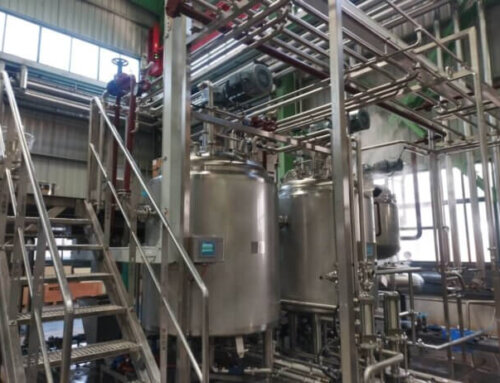
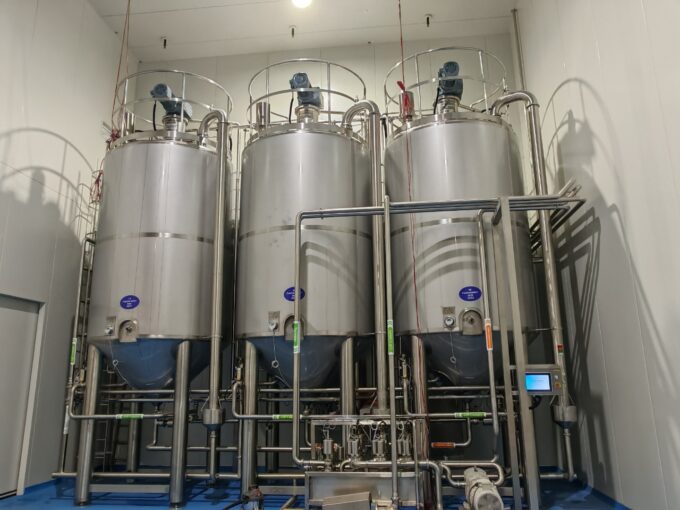
The fermentation system is a key section of the Greek yogurt production line, consisting of 12 × 10,000 L yogurt fermentation tanks, providing a total installed volume of 120,000 L.
After pasteurization and cooling, the yogurt base is transferred to the fermentation tanks and inoculated with the selected starter culture. Fermentation is typically carried out at 42–45°C for approximately 7–8 hours per batch, with the endpoint controlled according to the culture, formulation, acidity, and target pH.
Each tank features a large-blade agitator and V-shaped conical bottom for hygienic discharge and efficient product recovery. The fermentation process is fully automated, with temperature, time, pH, tank level, flow, and transfer sequence monitored and controlled by the central control system.
After reaching the required fermentation endpoint, the yogurt is transferred to the next processing stage. For Greek yogurt, it proceeds to centrifugal concentration.
Greek Yogurt Centrifugal Concentration
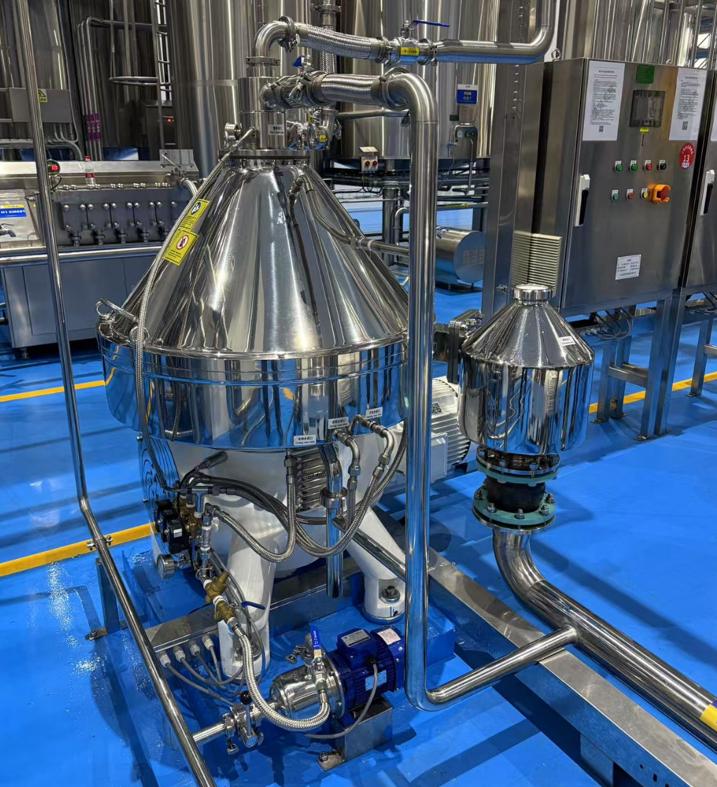
The fermented yogurt is transferred to the concentration section, equipped with 2 × GEA KDA30 centrifugal yogurt separators, each with a capacity of approximately 10 T/H.
The separators remove part of the whey to increase milk solids and protein concentration, producing the thick, creamy texture and high viscosity characteristic of Greek yogurt. The target protein content of the finished Greek yogurt is approximately 9.5 g/100 g.
The centrifugal concentration system provides continuous and efficient processing to meet the required production capacity.
Greek Yogurt Cooling System
After centrifugal concentration, the Greek yogurt enters the cooling section. The plant is equipped with two sets of tubular yogurt coolers. The concentrated yogurt is cooled to approximately 15°C before entering the buffer storage tanks. Controlled cooling is important for stabilizing the yogurt structure and controlling further biological activity after fermentation.
Because the finished products have different viscosities, ranging from approximately 641 to 3,390 cP at 25°C, the cooling and product transfer systems are designed according to the rheological characteristics of the different yogurt products.
Yogurt Smoothening and Buffer Storage
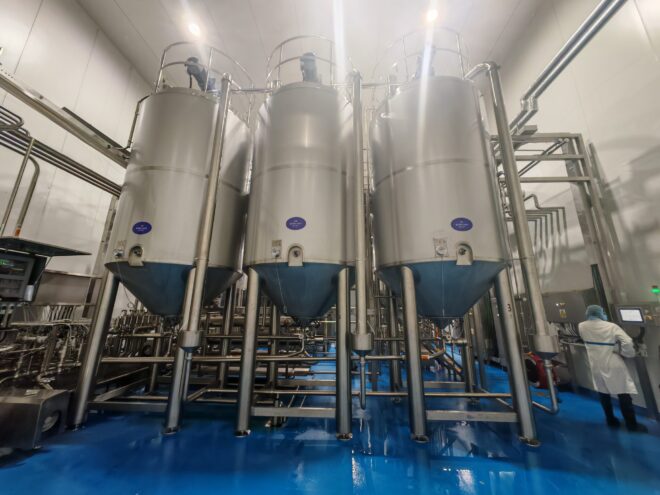
After cooling, the yogurt passes through two sets of yogurt smoothening pumps. The smoothening process helps achieve a more uniform product structure and consistent texture before filling. The project includes three 10,000 L yogurt buffer tanks. These tanks provide a hygienic buffer between the yogurt processing section and the filling machines. The automatic valve matrix system controls the product transfer from the buffer tanks to the filling section.
This arrangement allows the upstream yogurt processing system and downstream packaging system to operate efficiently without requiring perfectly synchronized production rates.
Automatic Yogurt Filling and Packaging
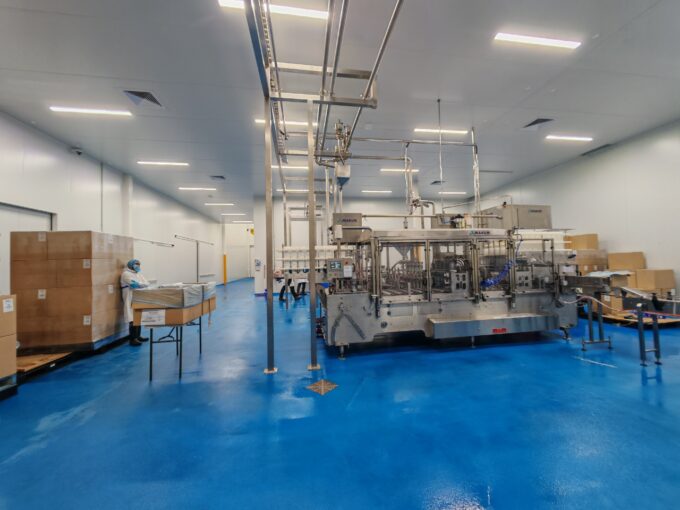
The plant includes four yogurt filling machines to handle different package sizes.
The final products are packed in:
- 170 g cups
- 210 g cups
- 700 g tubs
- 2 kg tubs
- 10 kg tubs
The different packaging formats allow the same production plant to supply both retail and foodservice markets.
The filling system is selected according to the product viscosity, filling temperature, package size, and required production capacity.
Two Independent Automatic CIP Systems
The project is equipped with two independent fully automatic CIP systems. Each CIP system adopts a four-tank, dual-circuit configuration with a 4,000 L capacity. The two CIP systems are separated according to the different production areas.
CIP System 1 – Milk Processing Unit
The first CIP system is dedicated to the milk processing section, including:
- Raw milk receiving system
- Raw milk storage tanks
- Milk standardization system
- Milk mixing system
- Pasteurization system
- Homogenization system
CIP System 2 – Yogurt Processing Unit
The second CIP system is dedicated to the yogurt processing section, including:
- Yogurt fermentation system
- Yogurt cooling system
- Greek yogurt concentration system
- Yogurt smoothening system
- Yogurt buffer tanks
- Product pipelines
- Filling system
Separating the two CIP systems allows the milk processing unit and yogurt processing unit to be cleaned independently. This arrangement helps reduce the risk of cross-contamination, provides greater cleaning flexibility, and can reduce production downtime.
Greek Yogurt Production Line Feature
Fully Automatic Valve Matrix Control: The raw milk tanks, standardization tanks, fermentation tanks, and yogurt buffer tanks are integrated with an automatic valve matrix system for automatic product transfer and process switching.
High Product Recovery: The pigging system recovers residual yogurt from the pipeline before CIP cleaning, reducing product loss and improving material utilization.
Flexible Multi-Product Production: The modular process design allows the same plant to produce Greek yogurt, non-concentrated sweetened yogurt, and non-concentrated unsweetened yogurt.
Efficient Greek Yogurt Concentration: Two GEA KDA30 centrifugal separators provide continuous yogurt concentration to achieve the required protein concentration and thick Greek yogurt texture.
Independent CIP Cleaning: Two independent automatic CIP systems separately clean the milk processing unit and yogurt processing unit, reducing cross-contamination risks and improving cleaning efficiency.
High Hygienic Standard: The main product-contact equipment is manufactured from SUS304 stainless steel and designed for automatic CIP cleaning.
Suitable for High-Viscosity Products: The yogurt cooling, smoothening, transfer, and filling systems are designed according to product viscosity, with the project covering products from approximately 641 to 3,390 cP at 25°C.