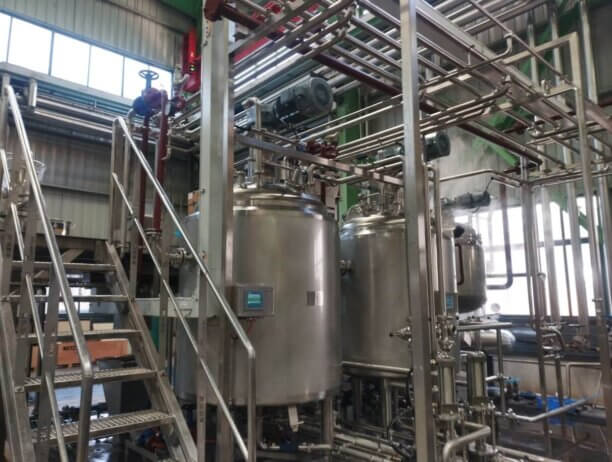
Project Overview
Azerbaijan has a long tradition of pomegranate cultivation and is one of the major pomegranate-producing countries in the South Caucasus. Pomegranate is an important agricultural and export product, with Goychay and other regions being well-known production areas.
In 2024, Azerbaijan produced approximately 192,000 tons of pomegranates, while around 33,900 tons were exported. This means that approximately 158,000 tons, or more than 82% of total production, remained in the domestic market or for other uses, including potential processing and value-added production.
The relatively large volume of locally retained pomegranates, together with Azerbaijan’s agricultural development policies, creates opportunities for expanding local fruit processing and value-added products. The Azerbaijani government has been supporting agricultural value-chain projects, including modern processing equipment, packaging and market development, with the aim of strengthening local production and increasing added value.
Against this background, a new 10 T/H pomegranate juice processing plant in Azerbaijan is being developed to convert locally sourced fresh pomegranates into 100% NFC (Not From Concentrate) pomegranate juice.
The plant is designed to process approximately 10 tons of fresh pomegranates per hour, operating around 20 hours per day during a 60-day harvest season(from October to November), with a total seasonal processing capacity of approximately 12,000 tons.
The project includes fruit washing and sorting, pomegranate preparation and aril separation, gentle juice extraction, screening, optional filtration, pasteurization, aseptic filling and storage, CIP, and process automation. Since fruit processing is concentrated during the harvest season while bottling is planned throughout the year, the project also requires a reliable aseptic storage and year-round bottling solution.
Here is the brief introductory data for this NFC pomegranate juice processing project:
Project Type: Pomegranate Juice Processing Plant
Location: Azerbaijan
Raw Material: Fresh Pomegranate
Processing Capacity: 10 tons/hour
Production Period: October to November, approximately 60 days per year
Annual Seasonal Raw Fruit Volume: 12,000 tons
Final Product: 100% NFC Pomegranate Cloudy Juice
Processing Technology: Gentle Juice Extraction + Finishing + UHT Sterilization + Aseptic Filling
Final Product Packaging: 220 L Aseptic Bags
Production & Storage Concept
During the pomegranate harvest season, fresh pomegranates are processed into 100% NFC cloudy pomegranate juice. After gentle juice extraction, finishing and UHT sterilization, the juice is aseptically filled into 220 L aseptic bags for storage.
After the harvest season, the aseptically packed NFC pomegranate juice is transported to a dedicated bottling plant, where it is used for year-round bottling and distribution.
Process Flow:
Fresh Pomegranate → Washing & Sorting → Preparation/Aril Separation → Gentle Juice Extraction → Finishing → UHT Sterilization → Aseptic Filling → 220 L Aseptic Bag Storage → Transportation to Bottling Plant → Bottling & Distribution
Project Capacity and Production Calculation
The preliminary production concept is based on:
- Raw pomegranate capacity: 10 T/H
- Operating time: approximately 20 hours/day
- Processing season: approximately 60 days/year
- Total seasonal raw fruit: approximately 12,000 tons
The calculation is:
10 T/H × 20 H/day × 60 days = 12,000 tons
The actual juice output will depend on the pomegranate variety, fruit maturity, raw material condition and extraction technology.
For preliminary engineering calculations, an industrial juice recovery rate should be confirmed through raw material testing and pilot trials. Depending on the variety and processing conditions, pomegranate juice recovery can generally be in the range of approximately 45–55%, while the actual commercial yield should be determined based on the specific raw material.
NFC Pomegranate Juice Processing Introduction
Pomegranate Fruit Reception, Washing and Sorting
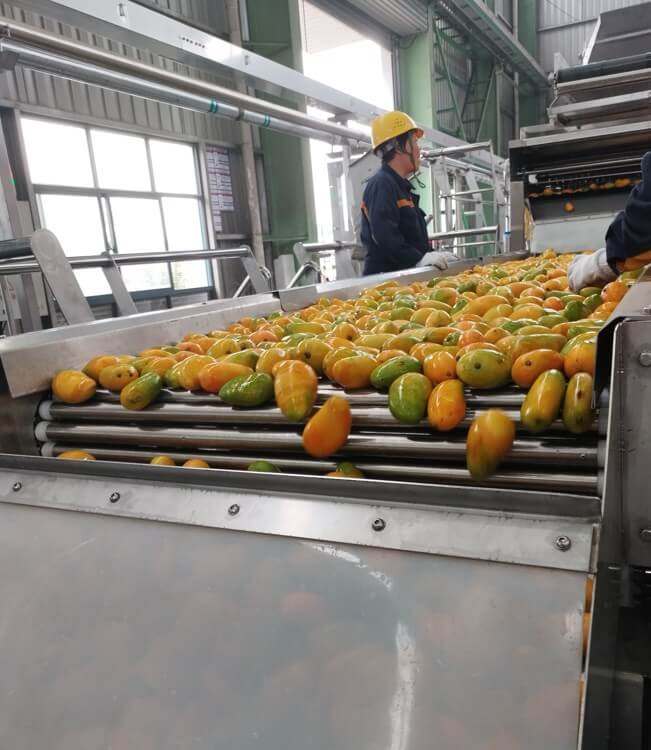
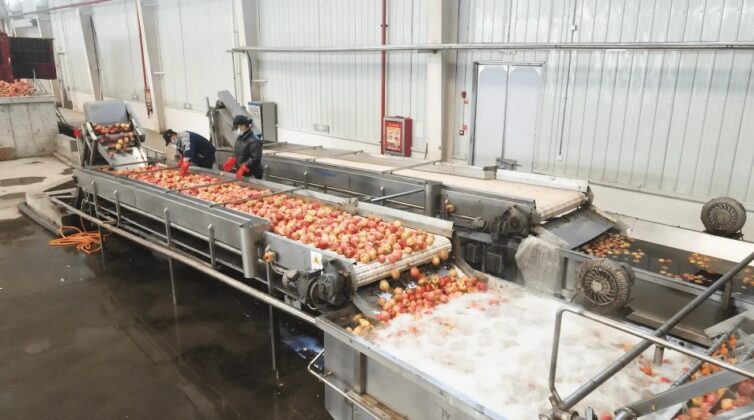
For a processing capacity of 10 T/H, the proposed plant can use a 10 T/H pomegranate fruit receiving, washing, and sorting system rather than installing two independent 5 T/H systems. The single higher-capacity system can include:
- Fruit receiving hopper
- Fruit conveying system
- Pomegranate washing machine
- Spray washing section
- Inspection and sorting conveyor
- Foreign material removal
- Fruit transfer system
A centralized 10 T/H washing and sorting line can reduce equipment investment, floor-space requirements and piping complexity. The final configuration can also be designed to allow downstream processing equipment to operate in parallel where necessary.
Pomegranate Preparation and Aril Separation
Pomegranates require specialized preparation before juice extraction because the fruit contains peel, membranes and arils.
For the proposed 10 T/H processing capacity, the preliminary concept is to use two pomegranate preparation/aril separation machines operating in parallel.
The two-machine configuration provides:
- Sufficient processing capacity for 10 T/H raw fruit
- Better operational flexibility
- Easier maintenance
- Partial redundancy during equipment maintenance
- More stable feeding to the juice extraction system
Gentle Pomegranate Juice Extraction by Belt Press
Juice extraction is one of the most important sections of a pomegranate juice processing line. The proposed system uses gentle mechanical extraction technology, such as belt presses. The objective is to achieve efficient juice recovery while minimizing:
- Oxidation
- Excessive shear
- Unwanted extraction of peel and membrane components
- Color deterioration
- Loss of natural flavor and nutrients
For a 10 T/H fresh pomegranate processing capacity, a properly sized high-capacity belt press can be considered for the main juice extraction system with 5 T/H presses.
A belt press is a continuous and gentle juice extraction system suitable for industrial pomegranate juice production. After washing, sorting and aril separation, the pomegranate material is evenly distributed onto a porous food-grade belt and gradually compressed by a series of rollers. The progressive pressing process efficiently releases juice while reducing excessive mechanical stress and helping control the extraction of tannins and other compounds that may cause bitterness or astringency.
The actual juice yield depends on the pomegranate variety, maturity, aril-to-peel ratio and pressing conditions. As a preliminary reference, 35–45% juice recovery from whole fresh pomegranates can be expected, with the final yield confirmed through raw-material testing or pilot trials. After juice extraction, the pomegranate pomace typically contains approximately 55–60% moisture. The pomace can be further dried using a belt dryer and processed into animal feed or other value-added products.
For a 10 T/H fresh pomegranate processing line, a 36–40% recovery would correspond to approximately 3.6–4.0 T/H of extracted juice before downstream processing losses. The belt speed and pressing conditions can be adjusted to balance juice recovery, product quality and natural flavor.

Pomegranate Juice Finishing and Screening
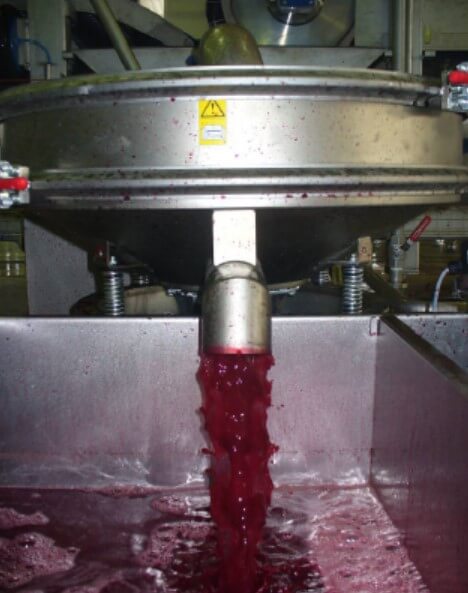
After extraction, the pomegranate juice contains fine pulp, seed fragments and other suspended solids. A finisher and screening system is used to remove coarse fibers and undesirable particles while retaining sufficient fine pulp for the characteristic appearance and mouthfeel of NFC cloudy pomegranate juice.
The juice passes through a finisher/rotary screen, with screen openings adjustable according to the required product quality. After finishing and screening, the juice typically retains approximately 3–8% suspended solids/pulp, depending on the raw material and customer’s requirements, before entering the UHT sterilization and aseptic filling system.
Pomegranate Juice UHT Sterilizing and Aseptic Bag in Drum Filling
After finishing and screening, the NFC pomegranate juice is subjected to UHT sterilization, typically at approximately 95–110°C for 30–60 seconds, to achieve commercial sterility while minimizing the impact on natural flavor, color and nutritional properties. For a 10 T/H fresh-fruit line, the expected juice flow after extraction and finishing is approximately 4.0 T/H, so the UHT system and aseptic filler can be selected accordingly.
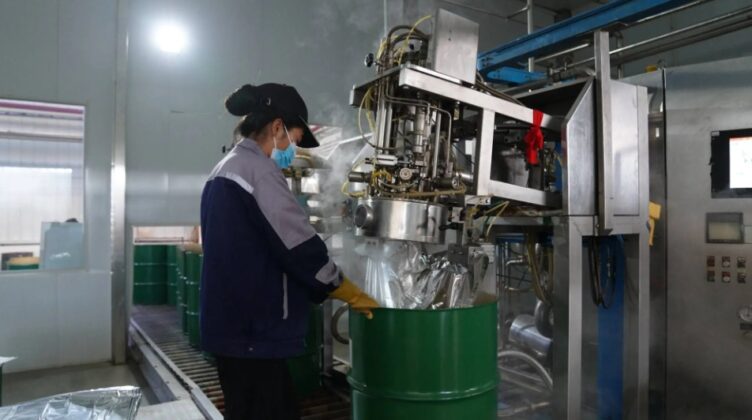
After sterilization, the juice is cooled to approximately 25–30°C and transferred to an aseptic bag-in-drum filling machine. Pre-sterilized aseptic bags are sterilized/conditioned before filling, while the product-contact and filling chamber are maintained under sterile conditions to prevent microbial recontamination. The juice is then filled into 220 L aseptic bags, sealed and placed in drums for bulk storage and transportation.
The filled product should be stored in a clean, dry and temperature-controlled warehouse, preferably below 25°C and protected from direct sunlight. Depending on the validated thermal process, packaging integrity and storage conditions, aseptically packed NFC pomegranate juice can typically achieve a 12-month shelf life.
Year-Round Pomegranate Juice Bottling
The customer plans to bottle the NFC pomegranate juice after the main pomegranate processing season. The initial bottling requirement includes approximately 3,000 bottles/hour based on 1,000 ml glass bottles. The bottling line can be designed separately from the seasonal fruit processing section.
This allows the factory to operate the pomegranate juice extraction and processing plant intensively during the harvest season, while the bottling operation can continue according to market demand throughout the year.